Friday, February 10, 2023

Pick Me Up: a Story of Losing and Love in Isolation, with Honey Snack Cake

Trigger warnings: loss, pregnancy loss, cancer, COVID, hospice, etc. etc.

Back in August, right before school started, my mother was diagnosed with stage 3 esophageal cancer. They caught it early enough, the doctor assured us, and we agreed on a chemo-surgery-chemo sandwich, depending on how things might go. 

My mother, always a cheerful and compliant patient (through back surgery, knee surgeries, bunion surgeries, and more hospital visits than I can count) embarked on the journey with her Rollator, mostly chauffered by my brother (who has been her caretaker these 20 years since my father died), sometimes chauffered by me. The last scan before surgery came back good: no evidence of the mass. She prepared for surgery to remove any last vestiges of the cancer.

And then, the week before it was supposed to happen, found herself in back pain again, so weak she couldn't leave her bed. She fell, twice, and was taken to the hospital. They encouraged her to eat, discussed rehab to get her back in shape for surgery. I went to visit on Saturday with my daughter, and she looked like she was returning to baby-hood. It didn't look good, worse than I'd seen her in a while.

Saturday night my daughter had friends sleep over for her birthday. And on Sunday morning, I woke up feeling miserable, and tested positive for COVID.

We called the parents to pick up their kids. My daughter cried, claiming her friends would hate her now, it was such a sad birthday. I began isolation in our bedroom, thinking good lord, now I've exposed not just my daughter and her friends but my own already-immunocompromised mother and the entire freaking hospital to COVID (I was masked of course, but we know that's not 100% perfect).

Sunday night my brother called. The cancer had in fact spread, and my mother was dying. It didn't even matter that I'd exposed her to COVID. She would return to her apartment this week for hospice care.

So here I was, stuck in isolation, quite ill with this stupid virus, hacking up a lung, while my brother was stuck moving my mother to hospice alone, coordinating nurses and aides, ordering a hospital bed, doing logistics.

I called my mother every day. Twice a day. It was all I could do. She has never figured out video calling (she is obstinate about technology, despite her compliance in all other ways), so I'd talk briefly with her until she was tired, telling her when she sounded more or less loopy and trying to entertain her with thoughts of things other than death, encouraging her to drink water, to eat so she could stick around long enough for me to see her.

By Wednesday, the day of her move, I felt so helpless and desperate I didn't know what to do with myself. My brother said I should start thinking about when I was going to come up. He said she wasn't doing much to sustain herself. What should I do? I asked him. I'm COVID positive. I'm not just a little symptomatic; I'm actually really, really sick. The urgent care put me on Paxlovid and walking felt challenging. I just wanted to sleep. I wouldn't trust myself to drive down the street right now, even if the other stars aligned. What should I do?

Of course, it's February. The month my father died, the month of my pregnancy losses. The irony of all of this is not lost on me. I determined that if I could do nothing else, I would get her to eat.

So I did what any other self-respecting human stuck in isolation while their mother is dying in hospice would do: I ordered GrubHub.

Tiramisu, I decided, was something she could eat. Soft, sweet but not sickly, loaded with calories. She mooned over an icee she'd had in the hospital; this would be better. I did the best I could with directions to her apartment in the senior living facility, and then realized the driver would never be able to figure out how to get in. I texted him my life story, weeping, telling him he was bringing tiramisu to my mother, dying in hospice, because I couldn't be there, because I was stuck in isolation with COVID. I told him he was not just delivering food, but delivering a blessing. He texted back: "don't worry I will do the best."

As I watched the little GrubHub car approach her place on my phone app, I texted him, asked him if he needed any help getting in. "Nope," he replied cheerfully. "I'm in!"

I cried. I thanked him profusely. I gave him the biggest tip he'd probably ever gotten from a single small delivery. He told me I was kind, that it was his job. I told him he was the kind one, that I was so very grateful.

My brother reported she ate half of it, more than she'd eaten of anything else in days.

At this writing, my mother is still alive. I don't know how many more days she will be on this earth. Maybe she is waiting until the 20 year anniversary of my father's death on the 19th to make this shitty month's irony absolutely complete. But I will always be grateful to the GrubHub driver, who helped me to feel a little less helpless in my COVID prison, whose tiramisu was a literal "pick me up" when I am coming to terms with another loss.

I've always included a recipe in my posts. Maybe it's a little weird to do that now, but this is something alone the lines of what my husband left as breakfast outside my door this morning, which he made last night. Things are going OK down there without me, I guess, regardless of the fact the Universe is completely shitting on me in other ways.

Honey Snacking Cake

3/4 c. runny honey
1/4 cup light brown sugar
1 large egg
1/2 c. canola oil
1/2 c. buttermilk, well shaken
1 t. vanilla extract
1/2 t. ground cinnamon
3/4 t. kosher salt
1 1/4 c. all-purpose flour
1 1/2 t. baking powder
1/4 t. baking soda
1/2 c.  sliced almonds

Place a rack in the center of oven. Preheat oven to 350 degrees. Spray and 8-inch square pan with nonstick cooking spray. Set aside.

In a large bowl, whisk honey, brown sugar, egg, oil, buttermilk, vanilla, cinnamon and salt until smooth.
Add the flour, baking powder and soda and whisk until well combined.

Pour the batter into your prepared pan, tapping the pan lightly on the counter to release any air bubbles. Smooth the top with an offset spatula. Sprinkle the almonds on top, if desired.

Bake until the cake is puffy and lightly golden, and a tester inserted in the center of the cake comes out clean, about 25-35 minutes. Cool the pan on a wire rack for 15 minutes. Serve warm or at room temperature. Will keep well wrapped at room temp for up to three days.

Notes (from Yossi's cookbook Snacking Cakes)
You could double the ingredients, skip the almond sprinkle and bake this in a 15-cup bundt pan, about 40-50 minutes. Let it cool in the pan for 10 minutes and then invert it onto a wire rack to cool completely. You could also use a 9x5x3-inch loaf pan, use only 1/4-cup of the sliced almonds for the topping and bake until a skewer inserted in the center of the cake comes out clean and the loaf is puffed and lightly golden brown, about 35-45 minutes. You could also bake it in a 9-inch round pan until a skewer inserted in the center of the cake comes out clean and the loaf is puffed and lightly golden brown, about 30-40 minutes.

Pin It

Monday, February 28, 2022

The King Cake Gift, and Coconut Flour Banana Chocolate Chip Bread

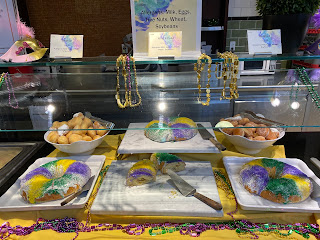
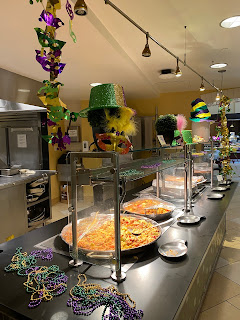
A few weeks ago, during staff meeting, my colleagues and I were reminiscing about pre-pandemic times in the dining hall, when the staff would put together a Mardi Gras spread like you've never seen: shellfish, po'boys, king cake, beads, you name it. We figured that the likelihood of a Mardi Gras celebration this year is pretty low, given that the dining hall has been short-staffed, supply chains have been unpredictable, and everyone is just plain old weary. I started waxing rhapsodic about king cakes, pining away for one, and one of our colleagues mentioned her friend's recommendation of Haydel's, which she said was the best king cake there was: totally authentic New Orleans.

I decided that I needed to order a king cake to lift everyone's mood. A real king cake, from New Orleans, from one of the famous king cake bakeries.

Except I didn't act on my plan until it was waaaaay too late to order  in time for Mardi Gras, at least from any of the big bakeries.

I took to Facebook, to see if I could find someone in the New Orleans area to pick one up and ship it. People had all kinds of good ideas (Goldbelly, etc.), but most of them were dead ends. Except one.

One of my friends suggested that I get in touch with a friend of hers, a "good guy," she said; "I bet he'd do it." So I messaged him, telling him that he didn't know me from Adam, but would he be willing to pick up and send me a king cake, and I'd venmo him whatever he wanted?

To my utter surprise, he said yes, sure, he'd do it. And, it turns out, his neighbor owns a coffee shop (hey, if you live in New Orleans, drop in and say hi from me, OK?) which gets regular king cake deliveries from Nonna Randazzos, one of the other big king cake bakeries.

When he told his neighbor about my crazy scheme, he gave him a king cake to send to me. He told me not to worry about the cake, and just sent me the receipt for shipping.

And so four days later, there I was, sitting in our staff meeting, with a fresh king cake from New Orleans.

And: I found the baby.

With all of the shit going on in the world right now, with so much pain and suffering and war and violence, that king cake was a glimmer of hope and faith in humanity.

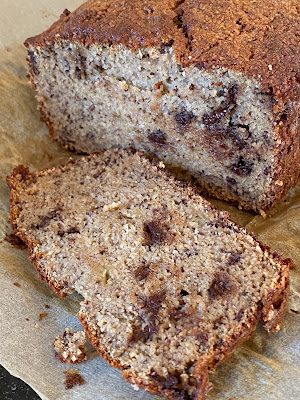
I didn't take any pictures of it, because it was too tasty, and we gobbled it up. But I'll leave you with coconut flour banana bread, which I made this weekend, and which is also pretty tasty, and because, chocolate.

Happy Mardi Gras, everyone. Lassaiz les bontemps rouler. The world sure could use some.

Coda: the dining hall did Mardi Gras after all. Jamabalaya, king cake and all.


Coconut Flour Banana Chocolate Chip Bread
adapted from detoxinista
For a while I was feeding this to my son for breakfast, telling myself that it was healthy and full of protein. You can tell yourself that, too.

3 very ripe bananas
3/4 cup coconut flour
5 large eggs
1/3 cup coconut sugar (light brown sugar works fine too)
1 t. ground cinnamon 
1 t. baking soda 
1 t. baking powder 
1/4 t. fine sea salt
1 t. vanilla extract
A generous handful of mini chocolate chips

Preheat the oven to 350ºF and line a 9-inch by 5-inch loaf pan with parchment paper.

In a large bowl, mash the bananas. Add the coconut flour, eggs, coconut sugar, cinnamon, baking soda, baking powder, salt, and vanilla. Whisk the batter together well, breaking up any lumps so a smooth batter is formed.

Pour the batter into the lined loaf pan and bake until the center of the loaf has risen and started to crack, feeling firm to the touch, about 45 to 55 minutes. Remove the parchment onto a rack and cool completely before slicing and serving.

Because this loaf is moist, be sure to store it in an airtight container in the fridge. It should last a week or so; you can freeze it, too, for a few weeks.

Pin It

Tuesday, February 1, 2022

The Care Ring and Murgh Keema

My church has a Caring Committee, which I co-chair. Last week, there was a flurry of messages and requests from folks around the very quick decline and (and unfortunate passing) of an involved and committed church member; she was admitted to the hospital for jaundice, came home with stage 4 pancreatic cancer, and was gone in a matter of days. She was a vibrant, creative soul, and it was heartbreaking and hard in so many ways for so many people in the fellowship. And selfishly, it didn't do much to make me feel better about feeling dismissed by doctors.

The Caring Committee is meant to be the Casserole Brigade, a temporary support system of regional Care Rings that activate when people are sick, or when there's been a loss, or when people need a grocery delivery or a ride: when people have an acute material need. Helping people to make decisions to get hospice care and getting them connected to the right resources are, unfortunately, out of our wheelhouse. But that's what people really seemed to want us to do, as her friends surrounded her, were stepping in to give her a sponge bath or other personal care. I spent a good part of the week trying to be clear about what the Care Ring could (e.g. remove snow and ice) and couldn't (e.g. call the social worker) do, reminding her friends that they also needed to tend to their own hearts and that even the most loving of friends can't be expected to do these things. I tried to let people know that there were going to be other opportunities to help, that there was a village, that one person didn't need to go rushing in and feel like no one else was there. I tried to help them understand that we needed to empower her and her husband to make difficult and painful decisions that maybe we didn't agree with. Or even to empower them not to decide.

Despite all that, while I felt like it wasn't fair to ask her friends to do those things, I also know that I would want a friend group like that if I knew I didn't have much longer to live. And when we learned she was gone, I know they were glad to have done these last things for her.

The other morning, seeing a photo post from one of those friends of a group of women eating and being silly and just enjoying each others' company, I confess I felt sad and lonely. I don't have a group like this, a group that I hang out with or go on adventures with or even eat a meal with when I'm not with my family. This is probably in part because I work full time and have chosen to prioritize my kids and cooking and things like that when I am home. I don't work hard at group friendship, I've never joined any of the covenant groups in my church (which are effectively social connections with a spiritual common ground). But it's also because I've just never really figured that kind of thing out. And sometimes, on the darker days, I wonder who will be there, besides my husband, if I ever need it. Maybe the Caring Committee will bring a casserole. But also maybe not. Because they didn't when I broke my foot in March 2020, or when I concussed myself in October 2020, or while I have been freaking out about my health over the past month. Then again, COVID. So no one was bringing casseroles anywhere. And ... I didn't ask them to.

I realized this morning that maybe the 300 pound gorilla sitting on my chest making me contemplate my own mortality is probably not just my own health stuff but also my body remembering February, which is my month of multiple pregnancy losses and the complicated loss of my father, as well as my daughter's birthday. So there's that. But still.

No Kidding in NZ posted the other day about needing a bigger support network. I couldn't agree more; if the pandemic has shown us anything, it's that we desperately need each other. I don't think that those of us who have children can take that care for granted, because we can't rely on our children to be our caretakers, especially if they need care, too. And the larger village is out there if we think about it. Sometimes it's just hard to remember who they are because we're not used to asking for help.

On that note, I called my endocrinologist on Friday, after some encouragement from Mel. He took my call right away, between patients, without me needing to leave a message, and said that it was clear that something is wrong, and it's just a matter of finding out what. He proceeded to order a ton more blood tests, so I left another few pints at the lab this morning. Which gave me some hope, at least, that maybe someone can help me figure out what the hell is going on with this crazy body of mine. 

And I go to the cardiologist on Wednesday to follow up on my two ER visits, but they called me yesterday morning. Apparently my two week heart monitor has shown ventricular tachycardia (the reason I wake up in the middle of the night feeling like my heart is pounding? is because it actually is pounding, at a lively 163 BPM). So I get to start taking beta blockers. Except that means I can't take the only thing that has made me sleep since my concussion in October 2020. Heart attack or insomnia from hell? I get to choose.

If I have to go on some kind of special diet, that will really curtail the bringing of casseroles.

Go give your Care Ring some love today.

Murgh Keema (or Turkey and Peas)
This is a recipe from Madhur Jaffrey's Quick and Easy Indian Cooking that I make often at home, and that the kids really like. It's the sort of easy to digest meal that I might bring over to a friend who isn't vegetarian. If you're vegan, you could definitely use Impossible if you're into that, or probably even tofu crumbles ... if you do that, let me know how it goes.)

3 T. vegetable oil
cinnamon stick
4-5 cardamom pods
2 bay leaves
1 small onion, peeled and chopped
3 cloves garlic, peeled and minced
2 t. peeled, finely grated ginger
1 1/4 lb. ground chicken or turkey
8 oz. fresh or frozen peas
1/4 t. turmeric
1 t. garam masala
1/4 t. cayenne pepper (optional; we leave this out for my daughter)
1/2 to 3/4 t. salt
2 T. fresh lemon juice
freshly ground black pepper

Heat the oil in a wide pan over medium high heat. When the oil is hot add the cinnamon, cardamom and bay leaves.  Stir for a few seconds.

Add the onion and fry until the pieces brown at the edges. Put in the garlic and stir for a few seconds. Add the ginger and stir for another few seconds.

Add the ground meat and fry and stir until all of the lumps are broken up.

Now add the remaining ingredients.  Stir and mix for another minute before  removing from the heat. Serve with rice, or quinoa, or naan, or whatever makes sense to warm your belly.


Pin It

Tuesday, January 25, 2022

When It's Just Not Normal

Somewhere midway through December, I called my GP to ask if I could come in. I was experiencing symptoms of a UTI, something that has happened with me occasionally as long as I can remember. Health care is slow these days, for all of the reasons we read about in the news, and they agreed to see me about a week later, for which I was grateful. I left a sample, and she prescribed me a three day course of antibiotics, just in case.

The culture came back negative, and I went on my way. Only the symptoms didn't go away. So I called again, a week later, asking if I could re-test.

"Your culture came back negative," they told me. "Everything looks normal."

Except it wasn't. I pushed them. My voice may have wavered. I didn't want to go back in for another doctor visit; I just wanted them to re-do my labs. Finally, reluctantly, they agreed. And got another negative culture, which I didn't hear about until I called them to ask about results another week later. Because no news is good news, right?

We went on a short road trip for the holiday break, staying far away from other humans. Symptoms were getting worse. I had to run to the bathroom constantly, was drinking enough water for a small elephant, found myself having to stop and rest frequently because my heart was pounding away at over 100bpm doing the simplest things, like standing in line or walking slowly. One morning, I woke up with a nosebleed. I was scared, and we headed home early.

The day after we got home, I called the GP again, left a message. Hours later, they called me back. Head to the hospital, they said. I felt abandoned, afraid of taking an even greater risk. But I did what they said. Six hours later, I was seen in a crowded, COVID-filled ER, where beds lined the hallways. They took my blood, took a sample, ran an EKG. Normal, they said, and gave me a 7 day antibiotic, just in case it was a UTI.

I went for a follow up to my GP, described my worsening symptoms. Palpitations. Loss of appetite. Back pain. She was distracted; she asked me questions that I'd just answered, ran me around the office hallway, impatiently trying to recreate the palpitations I was describing. I tried to explain that there were so many symptoms. She told me she had four more patients waiting. "Maybe it will just resolve on its own," she said, shrugging. Because all of my bloodwork came back normal. When I called again, they ordered an ultrasound, just in case, which I couldn't schedule for another week and a half, because the hospital is so busy and short staffed.

Another week went by. I couldn't eat. I called the doctor again, feeling guilty for doing so. She listened, hesitated. "Should I be prescribing you an anxiety med?" said the doctor. "Are you feeling anxious?" "I don't even know any more," I replied. Yes, I am anxious. About my health.

Things got worse. A strange, sour taste in my mouth after eating. My stomach growling and gurgling. Unquenchable thirst. Abdominal pain. A fear of straying too far from the bathroom. Urine that looked like water. Palpitations. I kept telling myself it was all normal, like they said. But I was also googling, and the things I were turning up said kidney failure. I was trying not to let anxiety compound what I was already feeling.

The ultrasound got postponed, because of "a change in scheduling" at the hospital. Another week.

On Martin Luther King day, I called them again. I left another message, told them I was worried, wanted guidance. I went to a Day of Service with my kids, kept my phone on loud so I could hear the ring. It never came. And towards the end of the morning, I couldn't get enough air. I told my kids as calmly as I could that we were going home a little early. My husband drove me to the ER, for the second time in three weeks.

Another ER, another five hours. More bloodwork. A chest x-ray, which is what they do when you complain about shortness of breath. A COVID test, which I knew would come back negative. All normal, they said. Or at least, this doctor said, in a way that felt almost angry, "sometimes the ER can't find the answer."

So who does, I wondered to my husband, on the way home? Whose job is it to help me feel better? To figure out what's wrong? Why am I in the position of trying to diagnose myself, when I am not qualified to do so?

There in the ER, I began thinking about the people who would care for my kids if I die. Not my husband, but the larger village. The people who would help my son figure out college, teach him to drive. The women who would be there for my daughter's first period. The people she could invite to her dance recitals, who would stand in together to be some semblance of what I would have wanted to be. I began thinking of all of the things I haven't done with my kids yet. The trips I wanted to take with them. The milestones I want to celebrate. I felt overwhelmed with grief. I’ve worried for fifteen years about losing them. Crazy, irrational fear, maybe, but I know that loss is possible. The thought of leaving them before I gave them everything I wanted to give them was too much.

A few days after I got home from the ER, the doctor's office called me. Twice. I ignored the first call, feeling despondent. What was the point? I answered the second call. A follow up, they said. I agreed, wondering whether I should try to find another GP, not sure where to go any more.

He ordered more tests. More bloodwork. I’m waiting for those results, feeling hopeless. This morning, I finally had the postponed ultrasound. Which came back…normal. I'm supposed to call a nephrologist, just in case, which will likely be another wait, because things are slow right now, and it's hard to get an appointment with a specialist, or with anyone. And still, no one knows what's wrong. My legs swell by nightfall. My heart pounds away whenever I'm not sitting still. My thirst is unquenchable. I strain to empty my full bladder. My taste buds are all messed up. Some days I don't want to eat. I've lost almost fifteen pounds. And I go to work, and cook dinner, and do the laundry, and act like everything is fine, because I am normal.

Only I'm scared shitless that something is really, really wrong.
Pin It

Friday, September 24, 2021

Life's uncertain, eat dessert first.

When I was a college student, there was a pub-like place at the edge of campus where my parents would sometimes take me on weekends when they'd visit. They had a vast glass case full of cakes of all sorts, and I loved going there, not for the food, but for the treats; in fact, the menu they'd hand you had the desserts listed first. And their motto, printed on every napkin, was "Life is Uncertain: Eat Dessert First."

I've been thinking a lot about that recently, for a lot of reasons: a while ago, one of my best friends from college -- with whom I was woefully incommunicative -- effectively dropped dead when his heart stopped beating, and in a stroke of amazing luck, it started again, but now he has a pacemaker. And then there's the whole pandemic, which finally motivated me and my husband to write our wills, because we realized that it's actually possible that both of us might die at the same time.

And then the other night, my daughter confessed to me that she doesn't like to be alone at night, because she starts, in her words, "remembering that I'm a person. And people die ... but I don't want to die, and I don't want YOU to die."

Deep existential thoughts for a ten year old.

We talked a lot that night, in the dark, lying side by side in her bed, about how it's true, people die, and it would be wrong of me to deny that, or even to promise her that I will live a long life. Because the truth is that none of us know. And thinking about that IS scary. I tried not to tell her how often I worry about this, too: that my miracle child will leave me, that I won’t have had enough time. We talked about how children who are diagnosed with terminal illnesses sometimes have to come to terms with that, too, and how incredibly unfair that feels. We did not talk about pregnancy loss, but we’ve talked about it before, and she knows that this is there too, the specter in the background.

And then we talked about how people sometimes deal with the uncertainty of life and death, with the help of religion, with the help of community, and with the humanistic approach of just making the most of as many moments as we can, remembering that we are human and celebrating it, rather than worrying about it.

Basically, eating dessert first.

This week was my son's fifteenth birthday. He's now taller than I am, and he'll be driving before I know it (he's taking driver's ed in school this year), and he has a lot to say that I don't always agree with. My daughter is starting to show the signs of growing up, too. It's a lot. It all reminds me that I'm a person. So I'm trying to get to the band competitions, and go for walks with them, and listen and play and talk, knowing that I don't have forever, even if I don't always get it right and do my share of yelling and don't always remember that it matters. Because given what we don't know, it's the most any of us can do.

Chocolate Cake

3/4 c. vegetable oil plus more for greasing pans
3/4 c. unsweetened cocoa powder (not Dutch-process) plus more for dusting pans
1 c. water
3/4 c. well-stirred canned unsweetened coconut milk
3 large eggs, warmed in shell in warm water 5 minutes
1 1/2 t. vanilla extract
2 c. all-purpose flour
1 3/4 c. sugar
2 t. baking powder
1/2 t. baking soda
3/4 t. salt

Heat oven to 350°F with rack in middle. Oil pans and line bottoms with rounds of parchment, then dust sides only with cocoa powder, knocking out excess.

Whisk together water, coconut milk, 3/4 cup oil, eggs, and vanilla in a bowl until well blended and smooth.

Sift together flour, sugar, 3/4 cup cocoa powder, baking powder and soda, and salt into a large bowl. Add wet ingredients to flour mixture and whisk until smooth.

Divide batter between pans, and bake until a tester comes out clean and layers just begin to pull away from side of pans, 25 to 30 minutes.

Cool cake layers in pans on a rack 30 minutes, then run a thin knife around edge of pans and invert cakes onto rack. Remove parchment and cool completely.

Frost with your favorite frosting ... I like white, because it makes for a nice contrast.


Pin It

Wednesday, May 5, 2021

No One Teaches You

(still editing this. But publishing it anyway.)

Last week, we lost a student in my college. I knew the person only a little bit, but the staff, our students, our community has all been devastated by this incalculable, unimaginable loss, which comes during a time of so much other loss, on top of the stress of the end of the term, not to mention a year in which systemic racism has been a constant conversation and many people are re-living traumas on a regular basis. It has just all been so much.

I debated whether to tell the small part of the student's story that I know, the window into what happened over the span of just a few days, and the awful feeling in my stomach when I knew in my gut what I didn't want to know in my head, but decided that it is not my story to tell. What is my story to tell, though, is that this past week has made me so grateful for the ALI community that I met through his blog.

There are no words that can offer any comfort to a parent who has lost their only child. This isn't how it's supposed to go; you're supposed to have children (multiple children), and live a long happy life to see them grow up and have their children. That's the story we are told.

Of course, we in this community know that this story has many different and difficult endings, or at least that it unfolds in many different and difficult and sometimes tragic and devastating ways.

As a nation, as a culture, we are not very good at dealing with death. We don't like to talk about it because it reminds us that we're not immortal, that the narrative is flawed, and we're are an optimistic country, so mortality is not something we like spending time considering. If you want proof, just look at how we dealt with the pandemic. If we were really understood and accepted mortality, maybe we would have taken more precautions collectively, looked out for each other.

On top of that, we're also not very good about talking about mental illness. While it's better than it was when I was a teenager, there are still stigmas around anxiety and depression that make it difficult for people to seek and get the treatment they need. 

So when mortality and mental illness collide, you can imagine how this goes. We come up pretty short. We want to make it go away. We don't even like to say, publicly, that this death was a suicide, because it feels like there is some shame in this act. We question ourselves, wonder what else we could have done, try to find someone or something to blame. All of this makes talking about it very hard.

Over the years, the ALI community gave me vocabulary and a way to sit with people who are grieving, people whose lives are not following the traditional script. We talk about death and loss in very public ways, we mourn together, we comfort each other, speaking the names of children we have lost. I learned the word "abide" here, even though we are rarely together in person to experience the solace of three dimensional companionship. Oddly enough, I learned here, in a space where we share words, that it's OK to not have any. I learned to sit in silence and presence.

I never want to have to have the kinds of conversations I've had last week. I don't think I've done it all right, or done enough, because those are impossible things to achieve. But I do know that I have been able to sit (virtually) in a space where I have no words, to abide (at a distance) with people who have experienced an unimaginable loss, and try my very best to simply be present, to bear witness. And I owe that to you.

Pin It

Sunday, May 2, 2021

The Empty Tub and Sri Lankan Dal

Almost a week and a half ago, I got my second vaccination. My husband is now more than two weeks out.

We've been following the CDC guidelines to the letter for the past year, masking everywhere, minimizing our exposure, reducing our grocery shopping. We sent the kids to hybrid school, so there was a risk, but there has been no in-school transmission. The kids haven't played with friends inside at all, and even when they're outside, they mask in close contact--no mater how brief--with everyone. Unfortunately, this has pretty much ruined my daughter's relationships with everyone on the street, who no longer ring our doorbell and ask her to play.

When this all started, my husband and I filled a plastic tub with two weeks' worth of nonperishable food, things that the kids could even cook if need be: pasta, beans, canned vegetables. There was extra toilet paper and tissues, cereal, applesauce and canned fruit. Flour for making bread in the breadmaker. We imagined what would happen if we both became ill, and no one else was able to come help. And for a year, the green plastic tub stayed in the corner of the kitchen, occasionally refreshed with a new box of cereal or bag of flour. Even in the corner, it was like an unspoken threat, more visible than the wills we updated in April.

This week, with a week to go until I was fully vaccinated, knowing that we wouldn't work through any of the groceries over the next week and that they'd still be around, I started to empty the tub, to put things away in cabinets where they'd normally go. The likelihood now of both my husband and me getting sick at the same time was much lower. We could get by on the things we usually keep in the pantry. It was a strange moment, exhiliarating and disorienting at the same time.

I know that we're not out of the woods. We will still mask, we will still be cautious, we know that it's not just about us but about protecting our whole community, especially given the new variants out there and the fact that right down the street in a town not far away the infection rates are still very high because people are living in much closer proximity without the privileges of protection (like the ability to work remotely) that I enjoy. The kids can't be vaccinated yet, and it's not clear when or if that will happen.

But for a moment, looking at the empty corner made me feel like maybe there is a light at the end of what has been a very dark tunnel.

Sri Lankan Dal
This is one of the recipes we discovered this past year; it's a good go-to that uses pantry staples, and is particularly warming and comforting, sort of like the lentil version of rice pudding, especially if you omit the turmeric and hot pepper, 

1 lb. red lentils
4 t. coconut oil
3 cardamom pods, cracked
1 cinnamon stick
3 whole cloves
1 large brown onion, peeled and thinly sliced
3 cloves of garlic, peeled and crushed
1/2 inch piece of fresh ginger, peeled and grated
2 green finger chillies, finely sliced (optional)
4 1/2 c. water
1/3 teaspoon ground turmeric (optional)
7 oz (3/4 c + 2 T.) coconut milk
1 1/2 t. sea salt

Place lentils into a sieve and wash until water runs clear. Place lentils into a large bowl, cover with water and set aside while continuing with the recipe. 

Heat the coconut oil in a large saucepan over medium heat until hot, add the cardamom, cinnamon and cloves. Stir-fry for about a minute, or until fragrant. Add the onions, cook for about 10 minutes stirring frequently, or until onions are soft and golden brown.

Next, add in the garlic, ginger and green chili, stir-fry for about 2 minutes.

Drain the lentils and place into the saucepan. Add the ground turmeric (I sort of like it without ... it tastes a bit more "homey" and sweet) and pour in water. Increase the heat and bring to a boil then turn heat to a simmer. Cook the lentils for about 20 minutes, or until soft. Once cooked pour in the coconut milk and add the sea salt to the lentils, stir and cook for a further 5 minutes. Remove from heat, cover and keep warm.

Pin It
Related Posts Plugin for WordPress, Blogger...