Showing posts with label low fat. Show all posts

Monday, November 25, 2013

Why Are We Studying Zombies? and Brains ... er ... Cauliflower Soup

The other day, during a meeting in which we reviewed the course offerings for the spring term (yes, really, all of them), it became obvious that the university was offering no fewer than three courses on zombies this semester, along with two one witches/mystics.  I never really got caught up in zombie-mania (that whole not-having-a-TV thing means that I never got addicted to The Walking Dead), but I have to admit, the fact that a student could practically minor in zombies at my place of employment shifted my perspective a little bit.

What is it about zombies, anyway?

I asked an old friend this question over tea the other morning; she works at a university press and was, herself, just about to go write copy for a book on this very same topic.  Her theory, which she'd borrowed from a co-worker, was that zombie-mania comes in waves, altering with vampires: that when the economy is tanking, we find fascination in vampires (a metaphor for our own guilty consumption), and when things are looking up, we like zombies: exuberantly consuming everything. Someone actually tracked this, and while the correlation is imperfect, it's not implausible.  But it doesn't get us anywhere.

There's another theory: that zombies allow us to express our fear of ourselves.  Of the unknown, the unpredictable in human nature.  The erratic infection that reanimates some humans, the frightening evil that lies embedded within us.  The thing that makes us heartless, soul-less, and nearly impossible to kill.  Because of all of the scary things in the world, zombies are just like us.  They are us.  And they're out to get us, too. 

I sort of prefer the second theory, probably because I'm a humanist and not an economist.  I'm interested in (among many other things, of course) the things within us that destroy us.  What makes people evil?  What makes us self-sabotage, and be willing to eat others alive?  What makes us lose our souls?  How do people prepare for the zombie apocalypse, and what does this mean about our own defenses against the dark arts?  This is, to me, the more interesting question for the college classroom.  It makes minoring in zombies seem like a worthy pursuit.

I'm not sure we'll ever get a satisfactory answer to that question; that's not what the humanities are about.  Studying patterns of zombie behavior isn't likely to protect us against them any better (though the writers of copious zombie survival guides would argue differently, I'm sure; they would encourage me, barn-owner that I am, to get the app.).  Then again, maybe it's like going to therapy: if you figure out the patterns of behavior, and can recognize them early enough, maybe there are some souls--even your own--that you can save?

Are you a zombie-lover?  What do you think about the fascination with zombies?  Are you prepared for the zombie apocalypse, just in case?

Cauliflower Soup
The cauliflower just looks like brains, right?  Once you blend it up, only your inner zombie has to know.

1 T. butter
1 T. olive oil
8 leeks, trimmed and finely chopped, white part only
2 onions, finely chopped
1 cauliflower head, finely chopped
2 small potatoes, peeled and diced
4 bay leaves
4 c. chicken broth
2 2/3 c. milk
salt and pepper to taste

Melt the butter and oil in a large stock pot or dutch oven over medium heat.  Add the leeks and onions, and saute until just beginning to caramelize.  Add cauliflower, potato, bay leaves, and broth and bring to a boil. Reduce the heat and cook, covered, until the cauliflower breaks apart easily with a fork, about 15 minutes. Discard the bay leaves.

Add the milk, salt, and pepper, and puree until smooth, either in a blender or with an immersion blender.

Top with shredded cheese, toasted almonds, creme fraiche, or snipped chives.
Pin It

Thursday, November 7, 2013

Bye, Bye Miss American Pie: Moosewood Apple Krisp

People can be particular about pie.  I should know.

I'm one of them.

According to my pie Rule Book, apple pies have apples in them.  In fact, when you cut an apple pie, you should have to use a knife.  None of this spoon nonsense.  If it's so full of goop that you need a spoon, you might as well be eating custard.

The problem with having pie standards like these, of course, is that they're impossible to meet on short notice.  You can't drive to the diner (blessed as we are in New Jersey with said establishments) for a slice of apple pie ... and expect pie.  That three dollar pie from the supermarket?  No dice.  Basically you have to make it yourself.  Which happens sometimes around here after 9 p.m., but not often.

Both S. and I have been craving pie, though.  And when I told him I was going to the supermarket for condensed milk to make Diwali sweets, he said, "if you're going out, pie would be good."

Of course pie would be good, we agreed.  But where would I get pie?  There's no pie around here.  Or at least, nothing worthy of the title.

I rummaged in the refrigerator, preparing lunches and snacks for tomorrow for the kids, informing my son, who had been in the shower for about half an hour so far, that he would have to eat around the bruise on his apple.  I don't think he heard me.

"I don't want to be here when you tell him again," commented my husband.  And then, thoughtfully: "Maybe it's a good night for crisp."

There's an idea, I thought.  Cook the damn apple, and my son will be none the wiser.  "Shall I start it?" I asked.  Of course I should.  I sprang to action.  An hour later, with marginal work: crisp.  Which is almost like pie.  Or at least, more like pie than pie pretends to be around these parts.

Moosewood Apple Krisp
I love the Moosewood version of apple crisp, because you don't need to feel too guilty about it, and because it comes together quickly.

8 - 10 medium apples, peeled, cored, and chopped
juice of 1 lemon
1/2 c. butter
1/3 c. honey
2 c. raw oats
3/4 c. flour
1 t. cinnamon
1/2 t. allspice
1/2 t. salt
1/4 c. pumpkin seeds
1/4 c. chopped walnuts
1/2 c.orange juice

Preheat the oven to 375F.

Toss the apples with lemon juice and a little cinnamon.  Spread half of them into a large baking pan.

Melt the butter and honey together.; add oats, flour, nuts, seeds, salt and spices. Crumble half of the oat mixture over the apples in pan. Cover with the remaining apples and the rest of the topping. Drizzle orange juice over the top.

Bake 40 - 45 minutes (25 minutes covered, 20 minutes uncovered).  Serve warm with ice cream.
Pin It

Saturday, August 17, 2013

The Quantification of the Self, and Eggplant Curry

I was given a FitBit, courtesy of Best Buy, for running the BlogHer 5K this year.  Lest you call me a hypocrite, let me be clear: I would have run the 5K even without the promise of swag. I was going to get out for some exercise that morning anyway, and put my re-sprained ankle to its first test.  But the FitBit did make getting out of bed at 5:30 a little easier.  And I've been wearing it ever since.  Somewhere, the leadership team of FitBit (which, by the way, has only one woman on it) is rubbing their hands together, cackling, "EXcellent."

True confessions: this isn't the first time I've owned one.  My first FitBit is probably buried somewhere in the Technology Drawer (which is a fancy name for the tangled mess of thumb drives, chargers, and connective wires necessary for all of our electronic devices -- the futuristic version of my mother's Junk Drawer).  My husband and I each had one, gifts from his company, which we wore religiously; he and I competed to climb the most stairs, to walk the most steps, and to grow the tallest flower on the tiny FitBit screen.  Come to think of it, I don't think he was competing with me.  But at the time, that was irrelevant.

One day, I guess I forgot to put it back on.  Or maybe I got frustrated and fired it.  So did my husband.  And you know how it goes.  Miss a day, miss two days, and your FitBit dies a quiet death in the Technology Drawer.

This time, I'm the only one with the device, and I thought perhaps it wouldn't hold such power over me.  But I check it, tap it, intentionally take the stairs even when I'm wearing less sensible shoes, partly because I know it's counting.  And I know that I am not alone in this behavior.

We quantify ourselves in countless ways.  If you don't have a FitBit, you have an iPhone app that tracks exercise and nutrition.  Or you look at your blog stats.  Or your grades in school.  Or the number of Twitter followers you have.  Or the number of Facebook friends you've accumulated.  Or shares of your social media posts.  If you're feeling lazy, you let Klout do it for you, and though you complain about how irrelevant Klout is, you check it anyway when it sends you email about your declining score.  There is, I discovered, even a Quantified Self movement and global conference: people out there dedicated to the cause of defining ourselves by the numbers (the Measured Me site is a notable example, in which the subject is quantifying even his happiness).  Assessment is the watchword of educational institutions.  We are all counting, and accounted for, especially in a competitive environment.

I was a qualitative researcher in grad school.  I did my time in quantitative fields: an English major, I still managed to get through Calc II and Linear Algebra; I aced programming and discrete structures; I passed my quantitative methods courses with flying colors.  But I always felt like there was more to the issues than numbers, and I was relieved to discover that I could still write a respectable (in fact, award-winning!) dissertation without statistics.

It's like achieving balance in the kitchen.  Baking is a quantitative pursuit.  You can fool around with amounts of fat and flour and sugar and leavening agent, but if you fool around too much, you will guarantee yourself some flat, or mushy, or otherwise undesirable cupcakes.  So, provided you like cupcakes, quantitative work in the kitchen is important.  But if you eat only cupcakes, you're going to get sick.  Cooking things like curry or soup or stir fry, on the other hand, is qualitative.  You add some of this, and some of that, and sub in something else that you prefer, you taste it off, and voila! you have dinner.  Which is, in the end, probably better for you than cupcakes.  Unless you're Julia Child, and you're making a roux or a souffle, in which case, you're counting, but you might as well add more butter and call it a day.

The bottom line is: we need both qualitative and quantitative measures of the self.  While some measurement is important, we are not merely the sum of numbers on a FitBit, or our social media reach, or grades, or the salary we make.  It's easy to forget that, given the emphasis we place on quantifying success (see Arianna Huffington's conference on the Third Metric).  But every once in a while, it might do us good to fire the FitBit.  Even if it means that occasionally, we end up taking the elevator.

Do you quantify yourself?  What are your reactions to the Quantified Self movement?

Eggplant Curry
Play around with this.  The second time I made it, I tossed in two handfuls of green beans instead of one of the peppers.  Add a few more tomatoes.  Vary the salt.  Whatever you do, enjoy it.

3 Japanese eggplants cut into rounds or 1 medium eggplant, chopped
1 green bell pepper, chopped
1 red bell pepper, chopped
1 large onion, diced
4-5 medium Roma tomatoes, diced
2 T. coconut oil
1 t. cumin seeds
2 T, ginger, grated
1/8 t. turmeric powder
3/4 t. garam masala
salt to taste
1 c. coconut milk

Heat oil in a heavy stock pot. Add cumin seeds; when the seeds begin to crackle, add onion and saute until it is transparent.  Add ginger, turmeric powder and garam masala and stir for a few seconds.

Add tomatoes and stir and allow to cook until soft and mushy.

Add peppers, eggplant, and salt to taste and mix well.  Cover and allow the bell pepper and eggplant to cook on medium low heat, checking regularly to stir, making sure that there is enough liquid in the bottom of the pan, and adding a splash of water if it's too dry.

When the vegetables are soft, add coconut milk, a little at a time, and stir gently over low heat (do not boil).

Serve with rice. Or whatever strikes your fancy.
Pin It

Tuesday, June 4, 2013

NaBloPoMo: The Story of a Potato, and White Beans with Cabbage and Potatoes

A few weeks ago, I noticed that the potato which had been living in the bowl on my counter had started to sprout.  At first, I was annoyed.  Another potato, wasted.  I pride myself on not wasting produce.  I plan meals, I buy what we need.  And I don't usually buy extra potatoes.  Because I don't even really like them all that much.  Which my husband thinks is akin to blasphemy.

But then, I wondered.  What would happen if I just let it grow?  It would be fun for the kids to watch, at least.

So I did a little research on the internet, poked some toothpicks into the side of it, put it in a glass that I refilled with water when I remembered to do so (which was probably less regularly than it deserved), and put it in a sometimes-sunny window.

At first, it grew slowly, trying to figure out which way to send shoots, and which way to send leaves.  But one morning I woke up and there were stalks.  And then, real leaves.

I should have planted it by now.  It could make me more potatoes this summer.  And (though I think I see one tiny little red potato growing already in the bottom of the cup) if I really want it to be healthy, it needs more than water and sun.  It needs soil.

But I've grown attached to my awkward-looking experiment, and I worry about what will happen when I change the equilibrium I've created. What if I break off these pieces, and they die?  What do I really know about potato farming, anyway?

When you try to root something, it's always a gamble.  I remember my father breaking off little shoots of plants he'd find everywhere, and putting them in a magical (and probably toxic) substance called "Root Tone," where they would transform seemingly overnight into full plants.  I was always enamored of his ability to make things grow the tiny little hairs that would sustain them once we put them in the soil.  Our house, when I was growing up, was filled with plants, many of them towering above me, or creeping, snake-like, across the floor; most of them were started from shoots.  But there were, of course, times when things didn't do what they were supposed to in Root Tone, when they turned yellow and died.  Because sometimes, they needed more.  And sometimes, they just weren't ready to root.

I've thought a lot about putting down my own roots here, where I am now.  How in some ways it happened so randomly (my husband and I were evicted from our last apartment because our landlord wanted to sell), but how it's become home, how I've created a network.   And how surprised I am that I have roots at all, despite the fact that I tend not to rely on people, that I tend to disconnect, that I've moved around so much during my life, even if most of it was within one state.

It's almost potato season for the CSA, and with the potatoes will come cabbage.  One of my favorite dishes to make with that combination lately has been Heidi Swanson's White Beans and Cabbage with Shallots, Potatoes, and Parmesan.  It's the sort of thing that's perfect for a cool summer night or even an easy lunch, perhaps with a glass of white wine.  Like my little potato plant, it's not beautiful, but it's simple, healthful comfort food.  I won't reprint the recipe here, but Sierra Madre Vineyards got permission to reprint it on their blog; here is the link to the recipe (and California folks, you can tell me if the wine is any good).

Have you ever tried to coax anything to grow roots?  Do you consider yourself a gardener?  Have you put down your own roots?  How random has that been?
Pin It

Friday, May 31, 2013

Hanuman, Anandam, Memory, and Chickpea Ratatouille

Each month, my yoga teacher focuses on a different asana to deepen our practice, and this month's theme was hanumanasana.  Hanuman, according to Hindu scripture, was the deity who reunited the lovers Sita and Rama, symbolizing the role of public servant, and seeker of truth.  We're also thinking about the second of the Yoga Sutras of Patanjali, and last night, my teacher was talking about the things that keep us from anandam, from bliss: the things that keep us from uniting with the truth.

One of these things, according to Patanjali, is reproducing memory, living as if what was true then is also true now.  Or distorting memory in ways that link it with other thought patterns.

I guess that's one reason that yoga has been recommended as a treatment for PTSD: to help us get closer to the truth of now, rather than inhabiting a past that our minds can embellish.  If we are focused on our breathing, on the position of our bodies in space, it's a lot harder to rehash the things that caused us pain; we are too busy with the process of reunification of self.

Mel posted the other day about refusing to get on an emotional roller coaster, and I could have sworn she was talking to me.  I've recently gotten back on a roller coaster that I thought I'd never get back on again.  It's a ride that takes me right back to where I was two years ago, with twists and turns and plummets into the depths that make me -- even now -- dizzy and sick: I have a strong visceral reaction to living in this space of memory.  I did it because I thought it would bring me closer to the truth.  I did it because I want, desperately, to do the right thing.  But sometimes it's hard to know what the right thing to do really is.

There have been a few times over the past few days when I look down at my daughter and realize that she is becoming this little person; I find myself wondering where this small, articulate little one came from.  I've been with her from the beginning, of course, but I will admit to being a very distracted parent over the past two years.  People have asked "are you enjoying your time at home?"  And I would have to answer, "well, sort of, but it's hard to focus on enjoying your time at home when you think you're supposed to be somewhere else."  It's hard to focus on being at home when you never know if and when you'll get a job, and you live in constant limbo.  (Sort of like being pregnant after infertility and loss.  Yes, you are happy to be pregnant, but you also know that at any moment you may lose everything, so you try hard not to attach at all.)  It's hard to focus on being at home when you feel like you're treading water.  It's hard to focus on being at home when you are depressed.  It's hard to focus on being at home when you feel like you are going to leap out of your skin at any moment, because this is not your life.  It's hard to focus on being at home when you are still stuck in the memory of what happened to you when this all started.

And now, I feel sad that I've squandered the time I had, the gift I had.  Not on purpose, but because I couldn't be present for it.  Still on the roller coaster, I try to drag myself back to the now, and notice the amazing little one before me.  Because she is what's real.

Om anandam, sachit anandam.  Welcome bliss.  Be present now.  And be gentle when the memories come.

Chickpea Ratatouille
This Mark Bittman dish from the April 2013 issue of Vegetarian Times is the sort of thing you can prepare and then step away from, so that you can spend more time being where you are, rather than where you think you're supposed to be.  This is not my mother's ratatouille.

1 lb. small eggplant, cut into large chunks
28-oz. can whole tomatoes, drained and chopped
3/4 lb. zucchini, cut into large chunks
1 medium yellow onion, sliced (1½ cups)
2 red or yellow bell peppers, cored, seeded, and sliced
5 cloves garlic, peeled and halved
1 t. salt
¼ cup olive oil
2 15 oz. cans chickpeas, rinsed and drained
1/4 c. chopped fresh parsley


Preheat oven to 425°F. Combine eggplant, tomatoes, zucchini, onion, bell peppers, garlic, salt and oil in large  roasting pan.

Roast 30 to 40 minutes, or until vegetables are lightly browned and tender, and some water has released from  tomatoes to create a sauce, stirring occasionally.

Stir in chickpeas, and roast 5 to 10 minutes more, or until chickpeas are heated through. Stir in parsley, and season with salt and pepper, if desired. Serve hot, warm, or at room temperature.
Pin It

Monday, March 18, 2013

Re-boiled.

If you're a parent, you've heard the admonition that you're going to find yourself saying the same things to your children that your parents said to you.  It's hard not to.  After all, we are good students, and those lessons happen at an impressionable age.  And we see ourselves in our children, too, don't we?  Sometimes the resemblance is obvious, and sometimes less so; sometimes it's physical, and sometimes something much deeper than facial features.  Sometimes it's flattering, and there is great joy in those moments.  Sometimes, it's anything but.

Especially when we see the parts of ourselves that we struggle with (or against) emerge in our children.


My son is sort of a perfectionist.  He's been that way as long as I can remember, lining up his vehicles in lines that had to go just so, having a complete meltdown when he doesn't do something exactly right the first time.  His teacher, in a recent conference, said that she noticed this quick frustration (to the point of tears) and it worried her, to see it in a child so young.  We do the best we can to prevent this from becoming a life-long obstacle.  Being encouraging.  Telling him that practice is important.  Assuring him that the mistakes are part of the learning process, and that everyone learns at a difference pace.  

But of course, this is my nature, too.  Having things just so.  Doing everything exactly right.  Never disappointing anyone.  Making everyone happy.  Or if I'm pissing people off, doing so with full knowledge and confidence that it's my intention to do so.  And as much as I try to be reassuring, I confess that sometimes I also respond to the things that make me frustrated by expecting him to be perfect.  Why didn't you get those math problems right? You know the answers.  Why can't you bathe yourself faster?  You're a big boy, you don't need me to supervise you every minute.  And so on.  Just, of course, like my father.

I also see him react out of anger, snapping with a quick temper, rage flaring up and going off like fireworks.  Which is also the way I've reacted to bottled-up anger over the years.  Quiet, quiet, quiet, and then BANG.

It's a scary negotiation, those moments.  Because I step back and see myself with a lens that makes me uncomfortable.

The difference, though, is that I see it, and talk about it, and let him know that I'm not happy with the way I sometimes deal with anger, or disappointment, or frustration.  And we try to talk about how both of us can problem-solve better.  

A few years ago, Brene Brown wrote, in her series about imperfect parenting, about the fact that parenting is a journey that we have to walk with our kids, while also continuing to figure ourselves out.  And in some ways, having kids forces us to figure ourselves out, even if we thought we'd figured out everything already before we started family-building.  (Good for you, by the way, if you have managed to do this.)  We may want to forget about our own flaws, or our own self-work, but we can't focus on our kids without looking a little more deeply at ourselves, too.

The other thing to remember about parenting is that as much as our children do resemble us, they are also, thankfully, their own people, subject to a different set of environmental conditions, and a different co-parent (or even in single-parent homes, different adult role models).  I know that there's hope for my son, because as much as he's a perfectionist, he's also, as my husband might be, perfectly happy with hastily written homework, or half-eaten sandwiches and crumbs on the counter, or pajamas on the floor.  And he's just as apt to walk away from a situation, or let his rage go, as he is to allow it to fester and scream.  Which are good reminders for me, too.

It's sort of like ribollita.  You start with bean soup.  And you cook it forever. And it's really good bean soup.  But then, you stop cooking it, and you throw in some bread, and you cook it all over again, and now it's heartier, and stronger, and more flavorful.  That goes for them, and for us.

I ate a soup like this in a small cafe in Kingston with a friend, at the end of a long weekend training program.  It wasn't quite ribollita, even though it was listed as such on the sandwich board (perfectionist that I am, I wasn't going to point out that they'd left out the beans and the bread).  But it was the sort of thing that had been cooked forever, which is sometimes exactly the kind of soup you want.

What traits did your parents have that you see in yourself?  If you have children, which of your traits, if any, do you see in them?  How has the "reboiling" changed you?

(not exactly) Ribollita

1 T. olive oil
4 stalks of celery, diced  
3 cloves of garlic, minced
1 yellow onion, diced
4 sprigs rosemary (2 T. dried)
3 sprigs fresh thyme (2 t. dried)
1 c. white wine
4 yukon gold potatoes, 1/2" cubes
15 oz. can fire roasted tomatoes
15 oz. white beans (optional) 
5 c. vegetable stock 
1 c. water 

1 bunch of kale, stems removed, leaves chopped  

Heat oil in a large stock pot over medium heat.  Add garlic, onions and celery and saute until just fragrant and beginning to become translucent.  Add rosemary and thyme, and stir until fragrant, a minute or two.  Pour in white wine, and reduce heat to medium-low; cook until the vegetables are tender.

Add potatoes and season with fresh ground pepper and sea salt.  Stir to coat.  Add tomatoes, beans (optional), vegetable broth and water and simmer on medium-low heat for 2 1/2 hours (or however long you can stand it), stirring occasionally and adding extra seasoning or water if necessary.

Remove the sprigs of herbs if they haven't disintegrated by now.  Add kale and cook until just tender and wilted, about 5 minutes, stirring occasionally.  Enjoy with a crusty white bread and the rest of your bottle of wine.
Pin It

Wednesday, January 23, 2013

Thoughts on Diversity, Understanding, and Justice: Kale and Fennel Salad with Apples and Cinnamon

When I went to graduate school for the first time back in 1995 for a PhD in English, my plan was to study "comparative ethnic literatures of the U.S." -- which meant, to me, studying the creative writing of non-white America, the experiences expressed in fiction and poetry by writers whose voices were less prevalent in the literary canon.  I'd written a thesis on Langston Hughes and Zora Neale Hurston and Alice Walker, because the language of their characters was like subversive music to me.

My own identity was conflicted: I was more or less a white girl with a father from Spain who immigrated to the U.S. via France (as a Jesuit charity boarding school student) and then Cuba, a place he lived for many years and left in order to avoid being executed.  I often checked the box marked "Hispanic" because that was what I'd been advised to do, because my cultural experience at home wasn't like other white families I knew, and because there wasn't really any box I felt could describe me.  I won a fellowship for underrepresented students, and felt guilty because I came from a middle-class family, even if my parents had worked hard to achieve that status.

I can't count the number of graduate school classes in which we engaged in impassioned debate about race, about whether people who could not self-identify as [African American, Black, Latina, Chicano, Korean-American, Asian, etc.] could write with any authority about the literature written by people who could.  We talked about whether people who were white literary critics were co-opting and colonializing literary studies.  And I wondered a lot about where I fit in, and whether I was deluding myself, thinking I could speak not necessarily for these writers and these literatures, but about them.  I wondered, too, whether there were any core elements common in human experience.  If we could ever sit down together and feel like the most important thing was our shared humanity.  I hated those discussions; they always made me feel bad about being, for all intents and purposes, white.

Though I ended up leaving that graduate program, the difficulty of advocacy stuck with me.  That difficulty had dimensions, too: it wasn't just about race, but about sexuality, about anything we couldn't change about ourselves.  How could we ever create a world in which people worked together for peace and justice if we could never fundamentally understand each other?

About ten years ago, I took a trip to South Africa with a group of educators and future teachers.  We were there to visit South African schools, to see the effects of apartheid on the educational system, and to make a contribution to South African education.  And to be honest, the more our hosts talked about difference,  described the ways in which apartheid had fundamentally shaped an unjust and well-entrenched system, and complimented our ability to overcome racism in the U.S., the more I felt like we were the ones who needed to learn something from them.  Because, of course, our racism is a lot more insidious.  A lot less obvious, perhaps, but in that way even more dangerous.

My friend KeAnne wrote a powerful post on Monday in honor of Martin Luther King Day, about how we continue to struggle to deal with difference in this country, in ways that are both transparent and invisible.  (Go read it; I'll wait.)  It got me thinking about my very racist father (his ideas always shocked me, given that he was also, technically, the minority), and about my own actions and beliefs.  About what I would have done in her shoes.  I think I probably would have done the same thing, and maybe I'm naive, but I don't think that it was racist.  Because I'm not sure whether she could have helped bring about change in that neighborhood from within it.  It's a tricky, and delicate, question.

My son and I did our annual viewing of the "I Have a Dream" speech on Monday.  He doesn't understand it all yet, because he's six, and the language is pretty complex, but I try to paraphrase for him as best I can.  I love this part best:

"I say to you today, my friends, so even though we face the difficulties of today and tomorrow, I still have a dream. It is a dream deeply rooted in the American dream.
I have a dream that one day this nation will rise up and live out the true meaning of its creed: 'We hold these truths to be self-evident: that all men are created equal.'
I have a dream that one day on the red hills of Georgia the sons of former slaves and the sons of former slave owners will be able to sit down together at the table of brotherhood. [...]
I have a dream that my four little children will one day live in a nation where they will not be judged by the color of their skin but by the content of their character."
Sitting down together at the table of brotherhood.  That's really what it's about, isn't it?  Not necessarily being able to live another person's experience, but to know that our destinies are bound up together.  The "salad bowl" metaphor for diversity in the U.S. has given way to other metaphors, and then lack of common metaphors at all.  We are a complicated place, and we don't all mix together easily.  I try to teach my son, and hopefully, one day, my daughter, that there's a lot that is the same about all of us and that the sameness doesn't make the differences any less important.

But here's what I think now, more than a decade after my graduate program days: you don't need to understand someone, exactly, or to have lived their experience, to be willing to listen, to be willing to work for justice, and to talk openly about what justice really means.  You need open eyes and an open heart, and you need to be willing to cultivate trust.  Maybe that's naive, too, but I need to start somewhere.

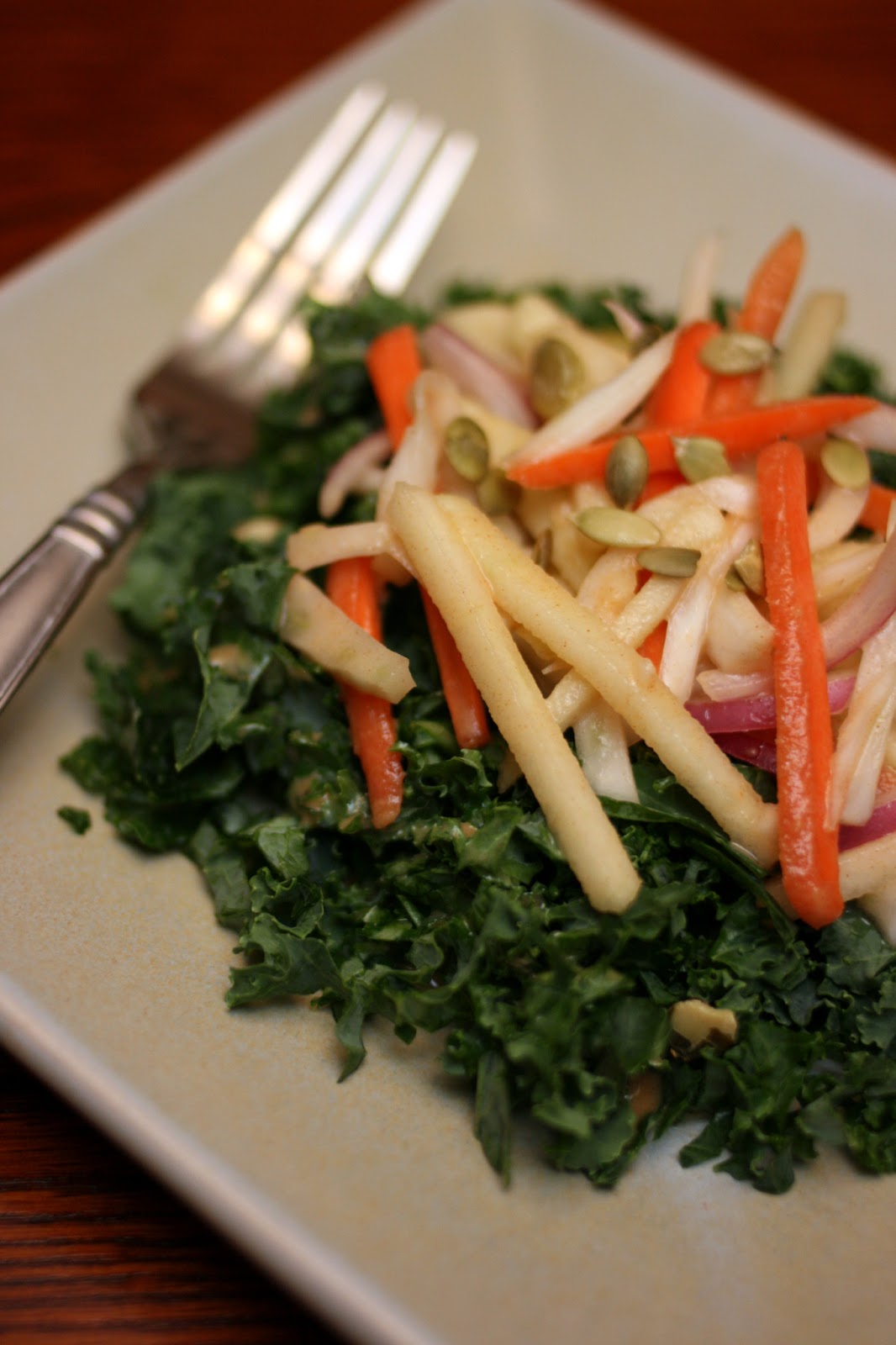
Kale and Fennel Salad with Apples and Cinnamon
adapted from Cooking Close to Home
I love this salad because it's both mixed and separate, because the flavors both blend and are unique.  It's a good salad to serve beside a warm winter soup.

Dressing
2 T. olive oil
2 T. honey
2 T. cider vinegar
1 t. garlic, minced
1/4 t. cinnamon

Salad
1/2 c. fennel, julienne
1/2 c. apple, julienne
1/2 c. carrots, julienne
1/4 c. red onion, julienne
1 1/2 c. kale, very finely chopped
a handful of toasted pumpkin seeds

Blend dressing ingredients together using an immersion blender (great for emulsifying) or a whisk.  Set aside.

Combined julienned ingredients in a large bowl and toss with dressing.

Evenly divide the kale among the serving plates, and top with mixed vegetables and fruit (this is also a fun job for the almost two-year-old).  Sprinkle with toasted pumpkin seeds.
Pin It

Sunday, January 6, 2013

On the Boycott of Playdates, and Raw Broccoli Salad

When I was little, we lived in a neighborhood in which there were always kids within walking distance.  Two sisters my age lived across the street.  A family with three girls lived up the block.  Two little boys my brother's age lived around the block.  And while I wasn't around much after school because my parents were both teachers and we spent a good chunk of the afternoon commuting, it was still nice to know that if I was bored, all I had to do was go ring their doorbell.

As I got older, and was entrusted to go a little farther on my own, I had a friend who lived two streets away, and I'd ride my bike to her house, where we would spend long afternoons pretending in her attic.  And finally, when I got to high school, I'd head by bike to a friend's house two towns and several miles away.

I know that this is a different time and age than the one in which I grew up.  But there are some things that I don't know if we need to give up just yet.  Like the impromptu doorbell-ring.

There are some neighborhoods where this is not possible, for a host of reasons.  The houses are too far apart.  There aren't enough similarly-aged children in the neighborhood.  You folks get a pass.

And there are some neighborhoods where the impromptu doorbell-ring (or simply entering with a passel of friends without the extra step of ringing) is alive and well.  You folks aren't the people I'm talking about here, either.

We live on a street with no fewer than five boys and girls who are I's age.  There are also three children N's age.  And yet, hardly ever does anyone ring the doorbell.  Instead, we organize elaborate playdates, mostly with children who don't even live on our block.

My son and I were talking about this one night, after I'd put him to bed.  About how I dislike the word "playdate," because it feels so contrived.  Like our toddlers need iPhones from birth, scheduling their play and organizing their relationships.  And how the arrangement feels exclusive to me; once you've committed to a "playdate" with one friend, you can't add a third random friend to the mix, who happens to ring the doorbell.


Partially as a follow-up to the conversation, the next morning, on a Saturday, I sent I. up the block to his friend's house to ring the doorbell, with instructions that upon the door opening, he was to invite said friend over to our house to play.  "But what if they're not home?" he worried.

"Then come home," I answered.

"What if he doesn't want to come over here, and what if he asks me to go there?" he asked.

"Then ask to use the phone, and call us to tell us that you're going to stay," I said.  "That's fine with me, as long as I know where you are.  And I'll tell you when we'll come pick you up."

"What if he doesn't want to play?"

"Then tell him thanks anyway, and tell him that you'll see him later, and come home."

He seemed satisfied with this, and skipped up the street.  It turned out that his friend's mom wasn't able to open the door, but she called later to bring the friend over to play for a while.  My son was thrilled.

Even as adults, we seem to tiptoe around each others' lives.  We don't call up friends without a reason any more, because Facebook takes care of our quick check-ins.  We don't drop by randomly for a cup of coffee, at least, most of us I know don't.  Or I don't.  And I feel like it's a dying art, the art of the unexpected visit, the art of intrusive friendship.  I feel like it's an art my children need to learn, if they're going to learn to notice people, and care about them, even when those people don't tell them that they need to be cared about.

So I've decided that for now, I'm going to boycott playdates.  I'm going to randomly call up my friends and ask if they want to come play [*edited later to add: with as much acknowledgement of work schedules as possible, and understanding when people have prior commitments!].  I'm going to send my children to ring doorbells, and interrupt our over-scheduled lives.  I'm going to welcome people to my house if they come calling, and always have something I can throw together and offer up as a light lunch.  Because sometimes the most fulfilling moments are the ones we never put on the calendar in the first place.

Do you -- or your children, if you have them -- ring doorbells?  Or do you tend to make plans to see friends?

Broccoli and Kohlrabi Salad
I've been thinking about this salad as an antidote to all of the unhealthy eating from the holidays, and with a crusty loaf of bread, it's a perfect throw-together kind of meal that's fancy enough to offer a guest.  Kohrabi is cool-weather vegetable, and one of the first and last things that we get in our CSA shares.  If you're looking through seed catalogues yet, as we often do here in the midwinter, it might be something to add to your order.

1 head broccoli, stems removed and cut into florets
1 c. kohlrabi, finely chopped
1/2 c. golden raisins
1/2 c. sunflower seeds
1 avocado, peeled and pitted
3 T. lemon juice
3 T. orange juice
2 T. lime juice
2 T. apple cider vinegar
1 T. agave
3 T. oil of your choice
6-7 chive blossoms (you may not have these right now, so you can always use a scallion or two, but the chive blossoms are really lovely and light)

Toss together broccoli, kohlrabi, raisins, and seeds.  In a blender, blend remaining ingredients.  Pour over vegetables.

Break apart chive blossoms into small bits and scatter over the salad.
Pin It

Monday, November 19, 2012

Difference at the Table: Moroccan Root Vegetable Stew

Despite my love of the harvest, and the falling leaves, and the apples and squash, and even the raking, I don't love November.

It's something about the darkening sky, the full-tilt rush towards Christmas and the pressure to give extravagant gifts, the starches of the Thanksgiving meal, the conversations I'm doomed to have around our Thanksgiving table.

World War Three, the Passive Aggressive version, came early this year.  With my mother's fall down her stairs, and her move to our house for her recovery, we've been dancing around difficult conversations for weeks now, me sometimes biting my tongue, and sometimes not.  Imagine Thanksgiving, with all of its family land mines, stretching out for three, then four, then five weeks, and you'll get some sense of what it has been like around here.

Reflecting on the difficult topic of religious pluralism in church this week, our minister reminded us of another meal that wasn't exactly the most congenial of meetings.

Edward Winslow wrote, in a letter dated December 12, 1621:
Our corn [i.e. wheat] did prove well, and God be praised, we had a good increase of Indian corn, and our barley indifferent good, but our peas not worth the gathering, for we feared they were too late sown.  They came up very well, and blossomed, but the sun parched them in the blossom.  Our harvest being gotten in, our governor sent four men on fowling, that so we might after a special manner rejoice together after we had gathered the fruit of our labors.  They four in one day killed as much fowl as, with a little help beside, served the company almost a week.  At which time, amongst other recreations, we exercised our arms, many of the Indians coming amongst us, and among the rest their greatest king Massasoit, with some ninety men, whom for three days we entertained and feasted, and they went out and killed five deer, which they brought to the plantation and bestowed on our governor, and upon the captain and others.  And although it be not always so plentiful as it was at this time with us, yet by the goodness of God, we are so far from want that we often wish you partakers of our plenty.
Can you imagine?  The Pilgrims had invited Massosoit to sign a peace treaty, and spent three days eating with ninety surprise guests with whom they couldn't communicate (except through Squanto), warriors who were bearing arms, not really sure whether they were going to be killed.  And you thought your Thanksgiving table conversation was a little tense?  Not that I am entirely sympathetic with the colonists, but it sort of puts things in perspective, doesn't it?  At least we're not armed.  And the one thing I've noticed is that over time, even if the conversations are still difficult, they've become less charged, as if time has diffused them, just a little bit.  Maybe we are figuring each other out, even if that understanding doesn't make us best friends.

Much has changed since 1621; though we haven't entirely abandoned our "roots," there's a lot on our Thanksgiving tables that is hardly "traditional" fare.  This dish is a nod to those early settlers and to their native American guests at the table, a stew made with traditional root vegetables, most of which actually were around for that first Thanksgiving (no potatoes, since they hadn't yet made their way across the Atlantic).  It's a perfect example of the meeting of cultures, American vegetables fused with the flavors of the Middle East.  Even if peace may be hard to imagine, perhaps at least we can appreciate the result of the marriage of flavors, knowing that the longer we sit around the table together, the more likely it is we'll at least achieve some kind of understanding, if not agreement.  And we can give thanks for that.

What--and who--will be at your Thanksgiving table this year?  What do your Thanksgiving roots look like?

Moroccan-Style Chicken and Root Vegetable Stew

4 c. canned low-salt chicken broth
1 T.olive oil
1 lb boneless skinless chicken
1 1/2 c. onion, chopped
3 garlic cloves, minced
2 t. garam masala
2 t. ground cumin
1 cinnamon stick
2 c. sweet potatoes, peeled, 1/2" cubes
2 c. parsnips (I used kohlrabi, because I had one) peeled, 1/2" pieces
1 1/2 c. turnips, peeled, 1/2" pieces 
1 large carrot cut in 1/2" pieces
1 c.  rutabaga, peeled, 1/2"pieces
1/4 c. golden raisins or apricots (chopped)1 14-oz can fire roasted diced tomatoes, drained
Juice and zest from one lemon

In a small pot, bring chicken broth to a boil, continue to boil until reduced by half, then set aside.

Heat oil in heavy large pot over medium-high heat. Sprinkle chicken with salt and pepper. Sauté chicken for about a minute until light golden and remove from pot; set aside.

Add onion to pot and sauté until golden and translucent, about 4 minutes. Add garlic and stir 1 minute. Add spices and stir 30 seconds until just fragrant. Add sweet potatoes, parsnips (kohlrabi), turnips, carrot, rutabaga, broth and currants. Cover and simmer until vegetables are tender, about 20 minutes. Add tomatoes, lemon zest with juice, and chicken, and simmer over medium heat about 5 minutes, or until chicken is thoroughly cooked. Sprinkle with cilantro if desired.
Pin It

Wednesday, October 24, 2012

Stranded: Chicken Pot Pie Soup

Noon on a rainy Tuesday.  The towtruck pulled up in front of my neighbor's driveway and began to slide the bed back, inclining it to the ground.  N. heard the commotion and went running to the door, pressing her face to the glass, where her breath made frosty marks around her small nose.

I'd been expecting the truck; my neighbor told me the other day, in her matter-of-fact way, that the van was going to be towed.  My neighbor is almost ninety, and the van has been uncooperative for a long time; finally, it rusted out completely underneath, leavings its entrails exposed to the elements.  But uncooperative as the van may have been, it was the symbolic representation of her independence.  It was her escape.  To the Amish market.  To the salon.  To the doctor's office.  To wherever she needed to go, by herself.

As I watched her from our doorway, standing on her own porch, I tried to imagine the thoughts in her head.  About borrowing her daughter's car.  About juggling rides.  About not going places.  About having to ask for help.

She stood there for a long time, stoic, half inside, half outside, newly coiffed with an auburn bouffant.  There were no tears; it was as if she was standing watch to make sure it all went right, rather than offering her last goodbye.  Finally, as the driver loaded the van onto the truck, she closed the door.  Perhaps she could take no more.

I believe that part of what has kept her and her husband alive and healthy for so long is their sense of independence, their sense of freedom. I can only imagine how difficult it was for her to give up that freedom.  She was, effectively, stranding herself.

My mother is also now stranded here.  She has no car, no friends, no lunch dates, not even 24 hour access to the Food Network, because we have no TV, much less cable.  She is in some pain; she can walk from room to room, but prefers not to move from standing to sitting positions more often than she has to.  She has to ask for help, and it's as if she doesn't quite know how; she doesn't want to be a burden, and yet sometimes not knowing how to help her is more burdensome than a simple request.  Today I helped her wash her hair in the sink, and take a sponge bath, and felt an awkward intimacy, almost like I was intruding.  These are things I do for my children.

This is a difficult negotiation for us.  There were times, as an adult, when I wanted her to be there, to support me, to tend to me, and she wasn't.  At least, not in the way I wanted her to be.  And I couldn't ask her to be, because that is not the person she is.  And yet now, I find myself in the position of caretaker.  Feeling like I ought not to be feeling sorry for myself, because she is the one in pain.

In her 2001 book Bodhichitta, Pema Chodron writes
"Bodhichitta is [...] equated, in part, with compassion—our ability to feel the pain that we share with others. Without realizing it we continually shield ourselves from this pain because it scares us. We put up protective walls made of opinions, prejudices and strategies, barriers that are built on a deep fear of being hurt. These walls are further fortified by emotions of all kinds: anger, craving, indifference, jealousy and envy, arrogance and pride. But fortunately for us, the soft spot—our innate ability to love and to care about things—is like a crack in these walls we erect. It's a natural opening in the barriers we create when we're afraid. With practice we can learn to find this opening. We can learn to seize that vulnerable moment—love, gratitude, loneliness, embarrassment, inadequacy—to awaken bodhichitta."
The soft spot.  Our innate ability to love.  The crack in my wall.  Maybe this is the moment that Pema would call the "teacher."

There is more soup on the menu this week.  The sort of soup my mother would like.  Because when you're stranded, at least you ought to have something you like to eat.

Chicken Pot Pie Soup
adapted from no, 2 pencil

2 T. butter
1 medium onion, diced
2 stalks of celery, diced
1 large carrot, diced
2 T. flour
2 t. sage
1 t. thyme
6 c. chicken stock - plus additional to thin if soup is very thick
3 c. shredded and 1 c. diced potatoes
4 c. cooked, diced or shredded chicken
1/2 c. evaporated milk (or heavy cream)
1 cup of frozen peas

Melt butter in a large pot over medium heat.  Add onions, carrots and celery and saute until softened. Add flour; stir well and cook about one minute more. Add herbs and chicken stock, increase heat to medium high. Once chicken stock begins to simmer, add potatoes and let simmer for about 15 minutes, or until potatoes begin to break down and thicken soup. Add chicken and let simmer until heated through, then add milk and peas and let simmer about 5 more minutes.

Add salt and pepper to taste, and adjust consistency of soup with additional chicken stock if needed.
Pin It

Monday, October 8, 2012

On Freecycling, and Healthy Pumpkin Pie Dip

I am the first to admit it: I have my father's frugal genes.

I hate being in debt.  I like a good bargain.  But I'm not a coupon shopper; rather than buying something at a discount, I will talk myself out of needing it or wanting it at all.  My husband often jokes that our relationship defies traditional gender conventions: he urges me to go buy myself some clothes, and I urge him to go buy a motorcycle.

The effects of my genes are further complicated--or perhaps even amplified--by a borderline obsessive desire to reduce, reuse, and recycle.  I'm the person who digs plastic bottles and toilet paper rolls from the garbage.  I save tissue paper and bags and ribbons from presents, to use again.  I write on the back of my shopping lists.

Which is why I love Freecycle.

If you've never Freecycled before, it works like this: you join a group in your region (a town, a county, even a workplace) where people post classifieds divided into three categories: OFFER, WANTED, and TAKEN.  The categories are self-explanatory.  People who want to give something away post it as an "offer."  Interested people contact the poster anonymously through the site.  The poster responds to the Freecycler of choice (usually the first one to claim the item) with information about location for pickup, and the Freecycler goes to pick up said item.  Quite often the item is left on the porch or in a mailbox or on a doorstep.  Sometimes the items are small: holiday decorations, lamps, salt and pepper shakers, DVDs.  Sometimes the items are large: exercise equipment, laptop computers, etc.

Though I already have standing arrangements to pass down my kids' clothing, I've been Freecycling a lot more lately, trying to find homes for things we don't need (we recently gave away N's pack and play, and crib, and some toys, for example), and trying to find things I do need that others might not.  And one of the things I could use are some new fall/winter clothes.

Don't get me wrong.  We are not impoverished, and my husband has encouraged me to go shopping.  He doesn't understand my fascination with, as he puts it, "clothes you find on the side of the road."  I joke that at least I haven't yet found a dress at the dump, as his aunt did for her daughter's wedding.  But I'm also aware that I'm not currently adding income to our household, and I hate buying something new that would be perfectly good used.

So I jumped when I saw the post.
OFFER: Large bag of women's clothes.  Most size M and some S.  Tank tops, long sleeved shirts, pants, shorts, a few gym clothes.

It was in a town about 15 minutes' drive away.  Totally doable.  I emailed the poster and said I'd be happy to come by if she didn't have any takers yet.  To my delight, she informed me that I "won," and that she'd leave the bag outside for me.

After I put the kids to bed, I left S. holding down the fort, and ventured out.  The house wasn't too hard to find, though it was dark, and I walked up to the door, squinting to see if I could locate said bag.  In the dim light, I made it out, sitting on a chair.  Much larger than I'd imagined.  And, picking it up, I thought, heavier, too.  WOW!

I drove home on winding country roads, listening to the radio, enjoying the crisp fall air, feeling extremely satisfied with myself, looking forward to the surprise of unpacking the bag.

And I was not disappointed; it was like Christmas!  What great taste this woman had!  What perfect colors!  I began to sort things into piles of "RIGHT SIZE" and "NO WAY IN HELL CAN I WEAR THIS," already thinking about how I was going to keep the cycle going with the second category. Wouldn't it be great to bring some of these to the next women's clothing swap at church?  Small, medium.  Small.  Small.  Medium, but ... er, nope, that doesn't fit.  Small.  Medium that really ought to be marked as small.  Medium that is skin-tight.  Suddenly the "NO WAY IN HELL" pile was much larger than the "RIGHT SIZE" pile.  And then, it had only two things in it.  Well, shit.  So much for Christmas.


I frowned, poking and prodding at my belly, which is a bit doughier than it used to be.  I still love Freecycle, though.  At least I'll have some great things to bring to the next clothing swap.

Maybe I'd better lay off the cake and eat more of this.

Healthy Pumpkin Pie Dip
Remember that really bad-for-you dip with the cream cheese and powdered sugar?  Try this instead.  Much more satisfying, and absolutely good for you.

1 c. canned or fresh pureed pumpkin
1 c. plain nonfat greek yogurt (vegans can also use coconut greek yogurt here)
1/2 t. to 1 t. cinnamon
1/2 t. to 1 t. ginger
dash nutmeg
sweetener of choice: a few drops of stevia, a squirt of honey or agave
apples for dipping (though you can also use graham crackers or animal crackers or gingersnaps)

Stir together all of the ingredients except the apples.

Add spice and sweetener as necessary.  Serve with apples to dip.
Pin It

Sunday, August 19, 2012

Neighbors: Peach Upside Down Cake

When I was growing up, there was a petite Italian lady named Mrs. B. who lived across the street from our house.  She was well into her eighties, but she was a spry, feisty little thing.  Despite her fairly constant claims of heart palpitations, telling us she "felt nervous" about one thing or another, we'd see her out sweeping her sidewalk almost daily in the summer, and raking endlessly in the fall, when her towering maple seemed to catch fire before it would drop its leaves.  In the winter, she would don her plastic bonnet with its chin-tie, and shovel herself out in the middle of a Nor'easter.  She drove her cream-colored Oldsmobile Cutlass long past the time when she probably should have stopped driving, giving us a near-heart attack every time we saw her backing out of her garage.  She had an opinion about everything, and she was quite eager to express it, motioning us close so she could stage-whisper conspiringly in our ears, shaking her head and wringing her hands at the absurdity of whatever happened to be the subject of the day.  Though we sometimes joked that she was the neighborhood busybody, she was also, admittedly, an effective one-woman Neighborhood Watch: she would peek out from between the Venetian blinds periodically when something was happening outside, and if she was concerned (which was more often than not), she'd give us a call.  We felt completely confident leaving our house on vacation, knowing that she would look after it for us.

As she got older, she would often come over to ask us for a favor: help her back out of the garage, help her lift something heavy, help her to reach something by climbing up a ladder.  Most times, when we'd do something for her, we could expect a cake to appear within the next few days.  We would joke about that, too, ask each other when the cake was coming if we thought we'd done something important.  But really, it was a generous gesture, and the most genuine way, for her, to properly express gratitude.

When we moved into our current house, I had pretty low expectations of my neighbors.  Besides Mrs. B., I'd had few experiences of close relationships with the people who lived next to us.  So I was pleasantly surprised when our neighbors began to become friends.

On one side of us lives a couple who is now in their nineties, an old farmer and vet whose wife reminds me a great deal of Mrs. B., armed year-round with her broom and her sharp tongue.  They brought food when our children were born and remember them every birthday and holiday, they lend us things like eggs and garden tools, they look after our house.  We shovel them out in the winter, help them with small maintenance tasks, and take an interest in their lives.  My husband often sits out on their porch in the evenings with Mr. H., drinking a beer with him and listening to him talk about his years in the war.

On the other side of us lived a woman who was the director of our county's domestic violence agency.  She had two older children, but adopted us soon after we moved in: she brought me chicken soup when I was sick, came over with tea to tend to me during the worst of my miscarriages, took in our trash cans, worried over us during visits from our parents, wrote love notes and gave gifts to our children.  We baked her birthday cupcakes, shoveled her out in the winter, lent her eggs, listened to her when she needed a convenient ear, and finally, hearts heavy, helped her to sort out her belongings to get rid of some before her move to the West Coast.

Our new neighbor, who moved in when she left, is different: still neighborly, as my husband described him, but not a friend.  He waves and makes polite conversation with us when we see him.  He bought lemonade when our son was selling it from our driveway.  He is still someone who we'd be willing to let borrow our hose and ladder, but not, perhaps, someone who would remember our birthdays, or pick up my son in a bear hug, or take care of us when we're sick, or come over for a lazy beer and talk after the kids go to bed.  He often makes a point of telling me how hard he's working (on his house and elsewhere), as if suggesting that I'm somehow not.  The other day when I was outside, he asked me where I. was, and, learning he was at camp, asked if there weren't other kids in the neighborhood he could play with if he'd been home.  I felt like he was criticizing me, but I didn't feel like telling him it was none of his business, nor did I feel like explaining to him about my job limbo, about what it's like to have two kids who are far apart in age and stage of development spend every waking moment together.  He's just not the kind of person I feel I can confide in.  After having such fabulous neighbors for seven years, I have to keep reminding myself that just because my neighbor isn't my best friend doesn't mean he's not a good neighbor.

***

There's been a lot of discussion around my little corner of the blogosphere lately about what makes a good member of the blogging "community."  For me, it's a lot like remembering that there are different kinds of neighbors.  Though we all live on the same block, our relationships can be very different.  Some of them we hold at arms' length, borrowing eggs and garden tools, waving when we see them outside.  Some of them come over for tea, take care of us when we are sick, remember our birthdays, become our friends.  Some of them argue with us about the fences between our properties.  And some of them watch over our houses from behind the venetian blinds, keeping us safe, and occasionally bringing us cake.

What kind of neighbors do you have?

Peach Upside Down Cake
adapted from Fatfree Vegan Kitchen
One of the cakes my neighbor Mrs. B. was known for was her pineapple upside down cake.  I had a peach version the other night that reminded me of her.  The one I'm posting here today is probably healthier for you than hers was, but it's still baked with love.

Dry ingredients:
1 1/2 c. unbleached white flour
2 t. baking powder
1/2 t. cinnamon
1/2 c. sugar
1/8 t. salt

Liquid ingredients:
1 c. vanilla soy milk mixed with 1 t. lemon juice
1/2 t. vanilla extract
1 t. lemon zest

4 c. peeled and sliced peaches (about 4 peaches)
1/2 c. brown sugar, divided (2 T. and 6 T.)
6 T.  cup natural, raw or brown sugar
2 T. water

Preheat oven to 350F.

Combine the dry ingredients in a medium bowl. Combine the liquid ingredients separately. Set aside without mixing them together.

Combine the peaches with the 2 T. of sugar. Wipe or spray a 10-inch, well-seasoned cast iron skillet with oil. Begin heating it and add 6 T. sugar and the water. Heat and stir until the sugar is completely melted and the mixture is bubbly and slightly reduced (but be careful not to burn it). Place the peaches on top of the sugar and remove from heat.

Add the liquid ingredients to the dry, stirring briefly, just to moisten. Pour the batter over the peaches, covering them entirely. Bake until the sides of the cake pull away from the edges of the pan and a toothpick comes out clean (about 30-40 minutes).

Allow the cake to cool in the pan for about 15-30 minutes, and then run a knife around the edges of the cake to loosen it from the pan. Place a large plate or serving platter over the top and invert the skillet. Remove the skillet carefully from the cake, and sprinkle, if desired, with a little bit of extra cinnamon.
Pin It

Aloo Baingan and the Art of Efficiency

I pride myself on efficiency.  When I had boring jobs back in high school and college like stuffing envelopes, I would spend the first few minutes figuring out how I could optimize envelope and paper placement so that I could move at the fastest speed.  When I'm cooking, I tend to try to do as many things at the same time as I can, stirring two pots with two spoons at the same time, doing dishes while something is simmering.

Which is why I had such a hard time in graduate school figuring out why I simply couldn't get it all done.  I found out later that no one else was actually doing all of the assigned reading, so my whole efficiency approach was shot to hell; it wasn't physically possible to do all of the reading.

Post-BlogHer, I made a commitment to myself to be more active in social media.  I already comment as much as I can on other people's blogs, especially if I know that that person is reading this blog (with apologies to WordPress people whose blogs don't always show up in my reader).  I have a Pinterest account where I pin beautiful food that I publish here and that I find elsewhere.  I created a Facebook account for this blog so please go make my day and like me there, and I've made more connections on Twitter (tweet me!).  Part of my previous reluctance was an attempt to keep my "real" identity separate from my blog identity; I think I've finally given up on that semi-anonymity.  So now I'm trying to keep up with all of it.

I still haven't figure out yet, though, how to be efficient about all of it.  Reading and commenting take up a lot of time.  And then reading Facebook.  Forget the Twitter feed, which is gone instantaneously if you're not watching it scroll by on your phone, or managing it on Tweetdeck, and if you follow a few people who post things every thirty seconds.

The efficient perfectionist in me hates this.  I keep thinking, there must be an easier way.

The SITS Girls tweeted on Thursday, asking tweeps what advice they'd give a new blogger.  I replied, "Build a supportive community by being a supportive community member."

But what does that mean?  How do you keep up with the social media maelstrom, especially if you want to engage people in meaningful conversation?

One place I love to be efficient is in the use of our CSA veggies.  When I can find a recipe that combines several vegetables from the share for dinner, I feel like I've conquered the box.  Here's one we ate this week.

Aloo Baingan
(adapted from here)

1 T. olive oil
1 medium eggplant, cut in half lengthwise, then cubed in 1/2" pieces
1/4 c. water
4 medium tomatoes, chopped
salt and pepper to taste

2 T. olive oil
1 t. mustard seeds
1 t. cumin seeds
3 garlic cloves, minced
1 1/2 t. grated ginger
1 large onion, finely chopped
1 large red bell pepper, seeded and cut into rings (1/2" thick)
4 medium potatoes, peeled and cut into 4 wedges (you can also cut them into cubes)
2 c. water

1 t. coriander powder
1 t. curry powder
1/2 t. garam masala
1/4 t. turmeric

Heat 1 T. oil in a non-stick pan on medium. Add the eggplant, a little salt and cook for a few minutes on both sides until it turns slightly dark and starts to soften. Add tomatoes, water, season with salt and pepper and cook covered for a few minutes until the fresh tomatoes are soft.  Set aside.

Heat 2 T. oil in a pan on medium. Add the mustard and cumin seeds, cover and let them splatter. Add garlic and ginger and sauté for a few minutes until fragrant. Add the onion, a pinch of salt to help it soften faster, and cook covered for a few minutes, stirring occasionally.

Add the red pepper rings and sauté for a few minutes. Add the potato wedges and cook covered for another few minutes, turning them around from time to time. Finally add the water, enough to almost cover the potatoes, the spices and cook covered for 10-15 minutes until the potatoes are tender but not easily breakable and the liquid has reduced.

Add the eggplant/tomato gravy and cook together for a further 10 minutes. Taste and add more salt if needed. If the curry is thick enough, keep the lid on for the last minutes. If it's still liquidy, keep it uncovered until it has the right consistency.
Pin It

Tuesday, August 14, 2012

A House of Compromise: Napa Cabbage Salad

I might as well confess this: my husband is a Republican.  In case you haven't been reading for very long, and didn't notice my political stripes ... well, let's just say I'm not a Republican.  Luckily we agree on the important ideological issues (at least, the ones I think are important), and disagree when it comes to issues of government size and fiscal responsibility.  It works for us.

As you found out in his guest post, my husband is an engineer.  He sees things with a scientific, rational, logical mind.  Me?  I was an English major, a Psychology minor, and got my doctoral degree in the Sociology and Philosophy of Education, heavy on the Philosophy.  I see things through the lens of metaphor, I am more likely to be emotional even when I'm being rational, and I am drawn to ideas about culture.  The difference offers us balance, most of the time, like when I want to cry about laundry detergent.  (Maybe sometime I will tell you that story, but not today.)

My husband is a carnivore.  He would be perfectly happy with a meal of hot dogs and mashed potatoes.  In fact, Thanksgiving at our house falls just short of a world war every year because though I am not exactly a vegetarian, I often eat that way, and I am the lone voice protesting the preponderance of starch and animal protein.  (A meal of sugar and fat, though?  Oh, ho!  Not a problem.)

Unlike most of our differences, which are completely surmountable or even useful, this last difference presents a challenge given that the CSA share is ... well ... full of vegetables.  And not just the flexible jack-of-all-trades vegetables like zucchini and tomatoes, but things like napa cabbage.  And eggplant.  And tomatillos.  I am way too lazy to make stuffed cabbage, and the idea of a whole head of cabbage worth of stuffed cabbage makes me a little weak in the knees.  I have eaten more baba ghanouj this summer than I thought possible, because everyone else who lives here thinks that eggplant is slimy.  And will someone please tell me what people do with tomatillos besides make salsa, or throw them in stew, which I really would prefer not to do when it's ninety degrees out?

I love my CSA.  LOVE, love my CSA.  But this is tricky business.

I remember having long conversations with a former colleague about her split household, and how she managed, as a vegetarian, to cook for herself and her vegetable-hating husband (not that my husband hates vegetables ... he just doesn't love them like I do).  At the time, they seemed like perfectly reasonable solutions: add beans to one half the meal, meat to the other.  But sometimes, like when you have a cabbage to contend with, it works less well.

You can, however, take a deep breath, compromise a little, and present your husband with a rack of ribs to grill as an enticement to eat said cabbage.  Which is exactly what I did.

Napa Cabbage Salad with Red Bell Pepper, Cilantro, Almonds, and Dijon-Ginger Dressing
(Adapted from Kalyn's Kitchen)

1 medium head napa cabbage, chopped (about 5-6 cups chopped cabbage)
1 red bell pepper, very thinly sliced into same-length slices
1/3 c. thinly sliced green onion
1/2 c. chopped cilantro
1/3 c. chopped almonds, toasted (or roasted, salted)

Dressing:
2 T rice vinegar
2 tsp. grated ginger root
2 tsp. Dijon mustard
3/4 tsp. sesame oil
1 T. agave nectar or 2 t. honey
salt and fresh-ground black pepper to taste
3 T. light olive oil

Stir together the rice vinegar, grated ginger, Dijon mustard, sesame oil, agave nectar/honey, salt, and pepper, then whisk in the oil one tablespoon at a time.  Set aside and allow flavors to mingle.

Toss together the chopped napa cabbage, red bell pepper, green onions, and chopped cilantro in a medium-sized salad bowl.  Add desired amount dressing and toss to coat the salad.  Place in salad bowls and top each serving with chopped almonds.  Serve and eat immediately, since the cabbage will begin to wilt in the refrigerator.
Pin It

Tuesday, July 24, 2012

The Politics of Chick(e)n

So I wasn't going to post about the whole Chick-Fil-A debacle.  I don't eat much chicken, anyway.  Or much meat at all, to be honest.  But the Muppets keep showing up in my FB feed, and after my homage to Kermit in yesterday's post, I'm taking it as a sign.

First, let me make sure you understand my lens on this: I'm a Unitarian Universalist (UU).  Which means I subscribe to seven principles and take my wisdom from six sources, including Jewish and Christian teachings about love.  I'd be that way if I weren't UU, too, but UUism helps me to name what I believe.  And I am pro-gay marriage.

I've known since I was a kid that something was different about Chick-Fil-A.  I think my mother was the one who told me that they closed on Sundays, though that didn't matter where I grew up because of the blue laws that closed the entire mall on Sundays anyway.  I knew that it was a business owned by a particular group of Christians (not to be confused with Catholics, according to my very-Old-World-Catholic father, and at that point I didn't really understand the difference between Baptists and Lutherans and Presbyterians and other sects), who really believed that the seventh day was for rest.  Honestly, I never gave their politics much thought.  It stands to reason, though, that the values of Chick-Fil-A's Baptist leader would align with the majority of established Baptist congregations in this country.

Where this begins to get tricky for people, so it seems, is drawing the line between the beliefs and actions of an individual--who happens to be a business leader--and the product of his organization.  The Muppets say you can't separate the two.  Others say you can.

I guess what it comes down to for me is that an individual with a particular belief system, who chooses to use the profits from my chicken sandwich to support organizations that I would not choose to support, may be a little less offensive on the scale of business-antiheroes than, say, a company that overtly discriminates in its hiring practices, or creates a hostile environment for employees and customers.  But if I know that my money is, in the end, going to support organizations that don't represent my beliefs, then I feel that I have the responsibility to act on that knowledge.  Maybe that's where Kermit is coming from, too.

Now, as KeAnne points out (in her fabulously written post on the subject, which you should go read RIGHT NOW), there are a lot of other companies out there, and a lot of other politics to wade through.  Sure, Haagen Dasz seems pretty harmless.  And ice cream is always a good alternative lunch.  But if I go digging deeply enough, what will I find?

This isn't the first time I've had to come to terms with the thorny problem of putting my money where my mouth, and head, and hands, and heart are.  (That is, assuming I'm ever faced with the unlikely situation that Chick-Fil-A is a real meal option.)  And I'm sure it won't be the last.  I would love to say that every time I make a purchase of goods or services, I know exactly where my money goes.  But the truth of the matter is for the most part, I really have no idea.  We get hand-me-downs for the kids when we can, and I'm not about to turn them away because they were made abroad in a factory where unfair and even unsavory labor practices prevail.  Though I cook most of our meals from scratch, and can get local eggs and butter and honey, I use things like sugar and flour and other pantry staples that come from large companies whose profits could be spent in all kinds of unsavory ways.  There are two problems here: one of them is that the chain of commerce is infinite, that even if I know about official company policy, I can't ever hope to track the expenditures of every employee (sort of along the lines of my MckMama post, there does seem to be a point at which a private person's life is just that: private); the second is my own lack of time to do even the most basic research in the first place.  And I'm clearly not alone: why did it take so long for people to put two and two together to figure out where Chick-Fil-A's leadership stood on the promotion of the "Biblical definition of the family unit" (Dan Cathy's words, not mine)?  Unfortunately, in the end, I suspect that time--of more correctly, lack of time--will often make my decisions for me.  It does now.

Still, in the case of Chick-Fil-A: my research has been done for me.  And as a supporter of gay marriage rights, I can't support a business that nurtures other anti-gay marriage organizations like WinShape.  So Chick-Fil-A can continue to serve up its patties.  And if, in this mostly-vegetarian household, I get a craving for chicken, I'll continue to make my own souvlaki.  (Which, if you're really not into chicken, would also be tasty when made with some hearty mushrooms.)

How about you?  How do you make decisions about companies to support with your business?


Souvlaki with tzatziki is the perfect way to use up all of those summer squash and cucumbers now filling your CSA boxes and farmers' market stalls, for those of you in the northern hemisphere.   Southern hemisphere residents: your time will come soon enough.

Tzatziki

1 c. Greek yogurt
1 cucumber, shredded, squeeze out excess water with hand
2 T. fresh lemon juice
1/2 t, salt
1 garlic clove, minced

Combine all ingredients together and stir well.

Souvlaki

6 T. fresh lemon juice
1 T. fresh oregano (or 1 t. dried)
4 t. olive oil
1 t. salt
4 garlic cloves, minced
1 lb. skinless, boneless chicken breasts, cut into 1” pieces (vegetarians can use portobello mushrooms)
2 zucchinis or other summer squash, cut into 1” chunks, halved if large
cooking spray or olive oil
pita bread (I used whole wheat)

Combine lemon juice, oregano, olive oil, salt, and garlic in a bowl. Add chicken pieces and coat well. Marinate in refrigerator for 30 minutes, turning once.  Remove chicken from bowl; discard marinade.

Light your grill and set it to medium, if you have some control over it.  Thread chicken and zucchini alternately on metal skewers (or wooden if you don't have metal ones, but makes sure you soak wooden skewers well in water first).  Spray grill with cooking spray or olive oil, and grill skewers, turning ever few minutes, until chicken is no longer pink inside (about 8 minutes).   Remove from grill.

Serve skewers with tzatziki sauce and pita triangles.
Pin It

Wednesday, July 18, 2012

Critical Thinking, Public Education, and Granola Bars


In which I get all political on you.  Apologies in advance to my regular readers who are patiently waiting for mindfulness and cupcakes.  Also, you owe it to yourself to go read Garage Author's post on this subject.  Because she writes like a champion boxer.  KO.

My son is going to public school at the end of August, so I find myself paying even more attention than usual to discussions of education policy (which is saying something, considering that I'm the daughter of two teachers, and spent my entire career in higher education).  Back at the end of July, the Texas GOP released its Education platform.  Usually this doesn't cause much of a stir, but they made this objectionable little comment that got everyone up in arms, and provided some useful fodder for Steven Colbert:
Knowledge-Based Education – We oppose the teaching of Higher Order Thinking Skills (HOTS) (values clarification), critical thinking skills and similar programs that are simply a relabeling of Outcome-Based Education (OBE) (mastery learning) which focus on behavior modification and have the purpose of challenging the student’s fixed beliefs and undermining parental authority.
Now, I do sort of understand the resistance to Outcome-Based Education.  OBE generally promotes curricula and assessment based on constructivism, which holds that people create meaning of the world through a series of individual constructs, or filters we choose in order to make sense of our reality.  While I consider myself more of a constructivist than not, and in principle this sounds like an excellent idea (and is the reason that we're beginning to see things like portfolio assessment of student work in addition to grades), in practice, it becomes a political morass.  How do you decide what the outcomes should be without getting all wishy-washy?  Where I used to work, that discussion resulted in a complicated core curriculum during the university's last revision of undergraduate education, which made no one happy.  I can't even imagine the discussion on a state level, especially when the state is the size of Texas.

But really? Challenging a student's "fixed beliefs" is a bad thing?  Should a child's lifelong beliefs be completely formed by elementary school?

A party spokesman later said ""[The chairman of the Education Subcommittee] indicated that it was an oversight of the committee, that the plank should not have included 'critical thinking skills' after 'values clarification, [...] And it was not the intent of the subcommittee to present a plank that would have indicated that the RPT in any way opposed the development of critical thinking skills."

Still, the fact that those words got written in the first place (which means they must have been spoken by someone, and read by many others before that document was released) is disturbing to me.  Isn't that what public education is about?  About encountering difference, about questioning your beliefs, about questioning what you've simply been told, about promoting democracy?  I'm reminded of the article that jjiraffe linked to the other day, about Mike McQueary, an assistant coach at Penn State who reported child sex abuse but is not being blamed for not doing enough.  At the end, the author writes, "[w]e need to find ways to teach Good Soldiers and Team Players to question authority while still respecting it. In fact, we need to go one step further and teach them that questioning authority is the best way to show respect for it. And any authority that challenges that notion isn’t worthy of respect."  As I wrote to jjiraffe, I'm not sure how we do that, exactly, but that kind of questioning is necessary if we're going to raise the next generation of heroes and whistleblowers, instead of people who stand by and watch terrible things happen.

The platform also opposes, among other things, early childhood education, sex education, and multicultural education, but supports “school subjects with emphasis on the Judeo-Christian principles upon which America was founded.”

Um ... excuse me? Wasn't it values clarification that motivated the colonists to travel here and stick it out against some pretty incredible odds in the first place?  And with growing populations of non-Judeo-Christian people who are influencing the future of the country, wouldn't it be important to discuss non-Judeo-Christian ideas?

You can read the entire policy here, if you're interested.  But I'm sorry, Texas GOP--as my son starts first grade this year, there is one thing I'm hoping he'll continue to learn: to think for himself.  And if he figures out that I've been wrong all along about something important, and can show me why in a way that is civil and respectful, more power to him.

Here's a great addition to a lunchbox for back to school, or to slip into your own bag, so that during that mid-afternoon dip in energy you can recharge your own power of critical thinking.  They're sort of like Luna bars, only more customizable and less expensive.  The basic formula from Brown Eyed Baker goes like this:

1. Rolled Grains (2 1/2 c.): Oats, Rye flakes, Barley flakes, etc.
2. Nuts, Seeds & Spices (1 c.) : Almonds, Walnuts, Pecans, Pistachios, Sunflower Seeds, Pumpkin Seeds, Cinnamon, Ginger, etc.
3. Sticky Sweetener (1/2 c., can use a bit more if you prefer): Honey, Agave Nectar, Molasses, Maple Syrup
4. Dried Fruits (1 c.): Raisins, Apricots, Dates, Figs, Prunes, Cranberries, Pineapple, etc.
5. Binder (1 c.): Pureed Dried Fruit, Apple Butter, Peanut Butter, Almond Butter, Unsweetened applesauce, etc.

Here's my variation on the theme.

What did you think of the document?  And how do you like your granola bars: chewy or crispy?

Luna Bar Style Tropical Granola Bars 

1 c. apple butter
1/2 c. raw local honey
1 t. ground cinnamon
3/4 t. vanilla
2 1/2 cups rolled oats
3/4 c. chopped almonds
2 T. raw pumpkin seeds
2 T. sunflower seeds (roasted, unsalted)
1 c. chopped dried apricot
2 to 3 T. unsweetened shredded coconut

Preheat oven to 325F. Line an 8×8-inch baking pan with parchment paper. In a large bowl, whisk together the honey, apple butter, cinnamon and vanilla extract. Stir in the oats, making sure that everything is mixed in well and that the oats are all moistened. Mix in the almonds, seeds, and dried fruit. Turn the mixture out onto the parchment and press into the pan, distributing it evenly and packing it tightly. Bake for 25 minutes. Remove from the oven and cool in the freezer until the bars are firm, at least 1 hour. Remove from the pan and cut into bars. Store in an airtight container for up to 1 week.  You can even cut them into fun shapes with cookie cutters!
Pin It
Related Posts Plugin for WordPress, Blogger...