Showing posts with label salad. Show all posts

Monday, October 28, 2013

(Skeletons) in my Closet, and Roasted Kale, Sweet Potato, and Toasted Farro Salad with Maple Dressing

When I started my first full-time job fifteen years ago, I wore a tailored pantsuit to work every day.  I was the youngest in my department, young in my field nationally, and after a very brief time away, I'd returned to the university where I'd been an undergraduate; I knew I was going to fight an uphill battle to be taken seriously, and clothing was part of my arsenal.  Though no one else in my office really wore suits at the time, doing so made me feel a little more grown up, and helped me--or so I thought--to convince other people that I wasn't a student any more, despite the fact that I probably still looked like one; in hindsight, I suspect I was trying to convince myself, too.  I was frugal, choosing conservative colors and styles, investing in a few high-quality pieces from respectable brands, rather than picking up a new wardrobe every season.  Black, brown: I was the university administrator equivalent of the corporate executive.  (And don't think that the fact that these were pantsuits is lost on me; I'm sure there are issues of gender and body image to unpack here, which I will leave for another day.)  I remember once gaping at a friend's walk-in closet overflowing with multicolored fabric and leather, like a visitor from a third world country who had just stumbled into Whole Foods. 

The same went for footwear.  I owned three, maybe four pairs of shoes: sandals, sneakers, heels from Payless, and a pair of mid-calf black boots--different ones as the previous year's specimens wore thin--that I referred to fondly as my "ass-kicking boots."  I never wore the heels, because the boots, like my suits, made me feel powerful.  They offered up a solid thunk, thunk, thunk as I strode across campus, pounded out determination and purpose.  I was a woman not to be crossed.  (Never mind that I wore said black boots with suits that demanded brown.  That was irrelevant.)

Under the boots, though, were the socks.  My true colors.  Wacky, bright, daring, colorful, and unmatched to everything else I was wearing.  They were the "if only you knew" part of my wardrobe, the secret that turned the corners of my mouth upwards in the more boring meetings.  The warm and interesting and creative part of me that made me a good fit for my work in the first place.

Sometime in the late spring, before I was hired at my new job, thinking that my professional future wasn't looking terribly promising, I purged my closet.  Some of the suits--the ones that no longer fit quite right, or that hadn't been worn in a while, or that went out of style years ago, even with my generous "style" window--went out with many of the books from my graduate school years, finding new homes in other people's closets or in the windows of local consignment stores.  Mostly, I kept the socks.

When I got a job in July, I took a deep breath and bought two new conservative suits, and few other things at an upscale local consignment store under the approving eye of a good friend, and figured I was done.

Except then I noticed that people weren't all wearing suits to work every day.  And that I wanted more variation in my wardrobe than the cloak of my former ambitions allowed.  Suddenly, what was in my closet was no longer enough.  Moreover, it was fall, and I realized that summer clothes really weren't appropriate for colder weather.  I didn't want to spend a small fortune dry cleaning my wardrobe every week.  And my old suits--the ones I hadn't purged--really were pretty old.

I bought a deep purple long sleeved dress with a daring v neck.  Some uber-comfortable flowy black Wearever machine-washable pants from J.Jill.  An olive-colored soft tee, which I haven't been brave enough to de-tag yet, feeling like it was a little too much.  A scarf, which I taught myself how to tie in a few different ways.  And today, knee-high brown boots--the first ones I've ever owned.  My side of the (non-walk-in) closet is back to full--even if it does have two season's worth in one place--with less consistency than ever among the styles and fabrics on the hangers.  Unlike in those early years of my professional life, someone looking at it wouldn't be able to identify my personal style at all.  Though it's not clear that in those years, the style was mine to begin with.

Still, I find myself--a little guiltily--browsing in the consignment store, trolling for a new skirt or two.  An interesting jacket.  It's like playing with costumes to find a skin I'm comfortable in.  And what I'm comfortable in isn't the same every day.  There's a little of everything, sort of like there was in the salad I made this weekend: warm and cool, "crunchy" and tailored, sweet and tart, fruity and nutty.  It's a different kind of powerful entirely than in those first days of my first job.

How does your wardrobe express you?  Your ambitions or your contentment with where you are?  Do you feel like you have a style?

Roasted Kale Sweet Potato Salad with Toasted Farro and Maple Dressing
I came up with this lightly dressed salad by playing with a few different recipes after the final installment of CSA kale and sweet potatoes this week, looking for something different to do with color and texture.  It tasted like fall.

2-3 medium sweet potatoes, cubed
2 teaspoons grape seed oil
½ teaspoon ground cinnamon
salt to taste (and pepper if you like)
1 large head kale, center ribs removed, chopped
1-2 apples, peeled and cubed (you can roast these for a bit too if you like; I prefer them cold and crunchy, to contrast with the kale and potato)
1 c. cooked farro
pumpkin seeds, toasted

Garlic Maple Dressing
3 T. apple cider raw vinegar
1 1/2 T. maple syrup
2 T. olive oil
1 t. Dijon mustard
1 cloves garlic, minced


Toast the pumpkin seeds until golden (I use a toaster, but you could also do this in the oven or in a hot pan).

Preheat oven to 400F and set aside a baking sheet.  Spray lightly with cooking spray.


Add sweet potato, oil, cinnamon, salt on baking sheet and toss with your hands until everything is well-coated.

Roast for 30-35 minutes (stirring and rotating halfway through) or until the sweet potatoes begin to caramelize (this is important to deepen the flavor of the salad, so be patient).  When the sweet potatoes are about 5 minutes away from completion, remove from the oven, place the chopped kale on top. Return to the oven.

Meanwhile, combine vinegar, maple syrup, garlic, and mustard in a small bowl. Pour in the olive oil, whisking as you go, and set aside.

In a skillet, heat 2 t. vegetable oil. Add the farro in an even layer and cook over high heat, stirring once, until toasted, about 5 minutes.  

When kale and potatoes are done, transfer to a bowl; add apples, farro, and toasted squash seeds, and dress lightly. Serve warm.
Pin It

Thursday, September 19, 2013

Catching More Flies: Peach Walnut Salad with Honey Mint Vinaigrette

I don't know about you, but this has been too much déjà vu for me.  Gunman with a history of mental illness enters a building to which he has legitimate access, opens fire, and mows down multiple innocent people.  An outraged public demands better gun control.  Media track down the gun purchase, only to discover that it's entirely legitimate.  A nation mourns.

My heart aches for the families of the dead.  But doesn't the fact that this continues to happen suggest that we need to consider a different approach to the problem?

As I've been following coverage of the event, I've been thinking a lot about Antoinette Tuff.  Remember her?  The Atlanta elementary school bookkeeper who averted the school shooting at McNair Discovery Learning Academy back in August?  If you haven't listened to the full 911 recording, you owe it to yourself to do so.  It's a remarkable example of our potential to humanize others, even in the moments in which they seem most inhuman:

http://www.slate.com/blogs/the_slatest/2013/08/22/antoinette_tuff_911_call_listen_to_the_full_tape_of_ga_school_clerks_call.html

Tuff begins the encounter by relaying the gunman's demands to the 911 operator.  But soon she begins to interject her own responses to his comments, and that, in the end, is what changes the situation.  In the moment when she chooses to validate him as a human being, to see him as something more than a gun-toting maniac, the monologue becomes dialogue: "He said he should've just went to the mental hospital instead of doing this because he's not on his medication. But do you want me to try - I can help you. Let's see if we can work it out so that you don't have to go away with them for a long time." As the conversation continues, Tuff connects with the shooter through her own vulnerabilities.  She talks with him about her own suicidal thoughts, her separation from her husband, her multiply disabled son.  And then, the part of the conversation that blows me away every time I hear it: "It's going to be all right, sweetie.  I just want you to know I love you, though, OK? And I'm proud of you. That's a good thing that you're just giving up and don't worry about it. We all go through something in life."

Love him? Remember, she is talking to a stranger who was, not minutes before, armed.

When, I wondered, was the last time someone said that to him?

What I don't understand is if Aaron Alexis was hearing voices six weeks ago, and actually told people about it, actually asked for help, why wasn't there someone to help him?  Where was the Antoinette Tuff of the Navy Yard?

There have been more "mass shootings" since Newtown than you've probably realized, since the FBI's definition of mass murder involves the killing of four people. Most of the shooters were unrelated to either most or all of their victims.  Most of them expressed some kind of desperation, some kind of estrangement, some kind of mental disturbance.  There was an insightful article in the NYTimes today about schizophrenia patients and the voices in our heads, suggesting that local culture plays a significant role in the manifestation of mental illness, and that if we--I would argue, patients and communities--treat unsettling voices with dignity and respect, then we can change them.
I'm not suggesting that we don't need to talk about gun control.  I have two small children, and I don't understand why civilians need to own semi-automatic weapons intended for military use.  But I also know that if someone wants a gun badly enough, he--or she--is going to get it, regardless of what the law says.  And I think that there's a lot of truth to the old adage about catching more flies with honey than with vinegar. 

We don't need all need to become social workers, or experts in dealing with mental illness.  But we can learn the equivalent of mental CPR.  And we need to see the mentally ill, instead of pretending that they don't exist, or that they're not our problem.  Because when someone decides to purchase a gun and kill twelve innocent people, it is our problem.

Isn't it about time we employed the ethics of care?

Peach Walnut Salad with
Honey Mint Vinaigrette

Here's a vinaigrette in which the tang is tempered by local honey.  Invest in a good one, because you will be able to taste it.

12 mint leaves, julienned
1/4 c. honey
2 T. rice vinegar
6 T. vegetable oil
pinch salt
4 or 5 ripe peaches, peeled and cubed
1/3 c. walnuts, toasted
8 oz. mixed greens

Whisk mint leaves, honey, rice vinegar, and salt in a bowl.  Continue to whisk while pouring in vegetable oil; mix until emulsified.  Add peaches and toss to coat.

Empty mixed greens into a large bowl.  Top with peaches and walnuts, and toss gently.  Serve.

Pin It

Sunday, September 15, 2013

Life Hacks, and Quinoa Avocado Salad

"Do you know what my best secret power is?" my father-in-law asked me, relaxing into the pillows on our couch.  He had driven five hours from New Hampshire the night before to help me corral and chauffeur children to school and day care while S. was away on business and I attended some evening programs for work.  I had been giving him directions for the evening, finding menus and money for pizza, discussing diaper changes, and reviewing the arrival of my son's bus.

"No," I said. "What's your best secret power?"

"That I know it just doesn't matter."  He gave me a satisfied smile.  "Whatever happens, I can handle it.  And in the end, it comes out fine."

I nodded, and grinned sideways at my son, who was still tying his first sneaker, three minutes after he'd started the process.  I was trying to get out the door at get to work, and it was taking all of my willpower not to grab the shoelaces away and tie them myself.  "Grandpa goes with the flow."

My father-in-law is not a Buddhist, but if I were going to conjure a contemporary Buddhist, he fits the bill.  He thinks nothing of picking up and driving to Florida on a whim to go kayaking.  He makes scores of plans, because even he recognizes that you can't do very much in life with no purpose at all, but then changes them when it becomes obvious that they won't work, for whatever reason.  He is completely unattached to the consequences of his actions, though he has, without a doubt, excellent intentions.

This is precisely where Buddhism stymies me.  The non-attachment to consequences.  Because if you're trying to do something positive, aren't you going to be a little frustrated when things don't work out?  How are you supposed to aim for good, but then simply decide that it doesn't matter?  That you've set things in motion, and that they will run their course?  It would be like a doctor prescribing medicine to a patient, and then feeling content when the patient doesn't get well.  If my father-in-law's secret power is that he can find it in himself not to care, my greatest limitation is that I care entirely too much.

It doesn't help that my secret power is organizing things to run like the Deutsche Bahn of old, before it started to lose its reputation for perfection and punctuality.

Then again, I guess sometimes you just have to approach life like a salad.  You start out with a bunch of high-quality ingredients, and you throw them together, with some sense that you're going to end up with something edible, even if it wasn't entirely what you intended in the first place.  Even I know that you can't save every patient.  Or win every tournament.  And if we couldn't accept that, at some level, we would suffer from perpetual paralysis.  Like yoga, it takes practice.  And my father-in-law has been practicing for a long time.

What's your secret power?

Avocado and Quinoa Salad

12 oz. red quinoa, cooked and chilled
12 oz. leftover cooked corn

1 c. finely chopped fresh cilantro
1 c. green onions, thinly sliced on the bias
1 c. tomatoes, 1/4-inch dice
2 avocados, peeled, pitted, diced

1/4 c. lime juice
2 T. olive oil
1 T. champagne vinegar
1/2 t. salt
1/2 t. pepper


In a large bowl, mix together cooked quinoa, corn, cilantro, green onions, and tomatoes. Gently fold in avocados.

Whisk together lime juice, olive oil, and vinegar, and mix until well-combined. Add dressing to the salad, and mix gently.  

Season with salt and pepper; serve.
Pin It

Tuesday, April 2, 2013

On My Own Terms: Yellow Split Pea Pesto

I've posted multiple times before about my beef with my family's holiday dinners.  In a word, I hate them.  Too many unnecessary appetizers.  Too much starch.  Too much animal protein.  Too many desserts.  Too much food in general.  And definitely too much indigestion-promoting conversation and family conflict.

I have hosted said holiday dinners for the past few years, mostly for kid-related reasons: easier to put babies and toddlers down for a nap in their own rooms; easier to let little people roam here than letting them loose in my mother's extremely non-child-proofed house; easier not to truck a carload of diapers, food, toys and other child accoutrements for a mere two hour visit when we could have two adults drive here instead.  But hosting holiday dinners also means that I do so on everyone else's terms. No one, for example, wants quinoa-stuffed acorn squash for Thanksgiving.  And while it's true that I could simply make people bring the foods they want to eat, I also feel strangely violated by those foods invading my table.  I neither want to have my mashed potatoes, nor eat them.  (Cake is another story.  But that's for another day.)  On a deeper level, I suspect that my discomfort is also about the politics that people bring to my house, and the words they bring that are not always kind, and the way that being with them makes me feel about myself.  It's like my own terms don't matter.

What's particularly odd about this is that I've done lots of big, scary things in my life on my terms.  I left my first graduate school program.  I left my position at my last job.  What was the difference, I wondered, as I agonized over another year's menu.  Was it because I felt like these things involved other people, and that the other people's desires superseded my own?  Was I really doing anyone any favors by doing something I didn't want to be doing, and then being grumpy about it?

I decided to try a small experiment.  Easter dinner is pretty low-stakes, after all.  No one really expects potatoes, for example.  So I didn't make any starch.  While ham is the Easter protein staple in my family, I refused to glaze it or do anything to it besides heat it. I made a simple steamed asparagus, and drizzled it with fig-infused balsalmic vinegar.  I put my husband in charge of making bread for people who needed to eat it.  I bought a single wedge of cheese to serve to people who absolutely could not survive without eating something in the half hour we had to be together before the meal.  And I made a split pea salad side dish adapted from my food guru Heidi Swanson, which served as the vegetarian entree ... for me.

It made a remarkable difference.

My husband tells me that I often act as if there is one way to do things in the world, and that's my way.  Which is completely true ... sometimes.  Even if it's a small thing, sometimes the small things matter.  Is that selfish?

When is doing things on our own terms selfish, and when does it count as self-preservation?

Are there small--or even big--things that you need to do on your own terms?  Do they involve other people, or just you?


Yellow Split Pea Salad with Pepitas and Pesto
adapted from 101 cookbooks
Have I mentioned how much I love Heidi Swanson?  I've been cooking my way through Super Natural Every Day and have not disappointed yet.  This salad was my"vegetarian option," and even the meat-lovers enjoyed it.  I made a few adjustments which I've reflected below: arugula instead of mixed lettuces (which was a nice spicy complement), more of the greens, less oil, less cheese, more lemon, more salt.  Vegan option below.

1 1/2 c. yellow split peas, rinsed and picked over
5 c. water
1 cup pepitas
1 cup cilantro leaves and stems, well washed and lightly packed
1/4 cup freshly grated Parmesan cheese (you can also use some large flake nutritional yeast and a bit more pepitas)
3 medium cloves garlic, peeled
2 T. lemon juice
1/2 t. salt
1/2 cup extra-virgin olive oil
3 c. baby arugula

Toast the pepitas in a toaster oven or a regular oven at 350 (or even a dry skillet) for about 3-4 minutes, or until you hear the pepitas start to pop.  Remove from the heat and set aside to cool.

Bring water to boil in  large saucepan.  Add the peas and cook until tender, about 25 minutes.  Rinse, drain, and set aside.  (Heidi says you can also use canned white beans, but I appreciated the slight crunch of the peas.)

Blend 1/3 cup of the toasted pepitas, cilantro, Parmesan, garlic, lemon juice, until the mixture has reached a smooth, paste-like consistency.  You can add a bit of the olive oil to make this happen if the mixture appears to be too stubbornly chunky.  Continue to blend the mixture as you add the olive oil

Toss everything but the agurula together in a large bowl until it is thoroughly mixed. Taste and season here with additional salt and pepper if necessary.  Add the arugula and gently toss again.
Pin It

Wednesday, February 13, 2013

More Greens, Served Cold: Envy, Energy, and Arugula and Pear Salad with Maple Dressing

So I've been thinking some more about--and working on quieting--the green-eyed monster since my post the other day about experiencing envy at the Y.

One of my instructors tore her meniscus recently.  It's clearly a very painful injury, and there's nothing you can to do fix it except rest it; you can't cast it, or medicate it.  In some cases it can require surgery, but from what I've read, that's a less desirable solution.  For a person whose entire livelihood depends on being able to teach fitness classes, and that career depends on being fit in the first place, a torn meniscus is really, really bad news.  Healing takes time.

Our instructor has continued to come and teach classes, demonstrating the exercises when she can, sometimes on one leg, pushing herself and us as hard as she can, stepping back when she has to, and often--I can tell by her contorted facial expressions--working through the pain.

(This in itself has given me pause.  When we injure ourselves, do we push through the pain?  Or do we stop and rest?  What does taking care of ourselves mean to us?  Is it different psychologically than physically?  I know that I've run or exercised despite injuries more times than I can count, altering my gait, gritting my teeth and telling myself that if I just work through it, I'll be fine.  Sometimes I am, and sometimes I'm not.  Is this a cultural thing?  I have worried for my instructor, but on the other hand, everyone else in the class seems to accept her presence, despite her injury, as a matter of course.)

The class I go to on Tuesdays is Tabata, which is essentially a high-intensity interval training class, with new exercises every week, which each person does as hard and as fast as she can, until we feel that our hearts will just about burst through our chests, and we suck in our air in great gasping gulps.  The great thing about Tabata is that it's an intense workout that is completely scalable to your ability and fitness level, and that you are called to do your personal best in a fitness class where no one passes judgement on what that personal best might be.  Though the Y is really supposed to be about community anyway, in some ways, Tabata unintentionally promotes mudita -- that empathetic joy I was talking about -- even more so in group fitness.  And just being together in that class encourages everyone to challenge themselves as they need to be challenged: so we are quite literally part of the larger energy that makes the work possible.

About halfway through Tuesday's class, my instructor, who had been nursing her knee for half an hour, finally sat on the floor, bent over her leg in obvious agony.  It was the worst it has been so far since her injury.  I watched her, and I wanted desperately for her to stop moving, to ice her knee, to sit there and call 9-1-1.  But she got up and finished the class on one leg, cheering us on.  She must have hated us then, in some way, being able to move and run and jump, but instead, she hollered and urged us to go faster-higher-harder, taking out her camera to film us, capturing the class energy in her pocket for posterity.

I thought about how incredibly generous that was ...what a gift it was to be there for us when she could not do the same for herself.  (I also wondered if it might be slightly insane, given that just being there and trying to teach might have jeopardized her healing process.)

Have you ever cheered someone on when you've wanted what they had, even though you couldn't attain it yourself?  Are you the kind of person who pushes on, despite an injury or illness?  What are the limits you draw on working through the pain?

Arugula and Pear Salad with Maple Dressing
adapted from Cooking Close to Home: A Year of Seasonal Recipes
When I make an arugula and pear salad, I tend to throw in the same things all the time: goat cheese and cranberries.  This isn't incredibly original, either, but I enjoyed the more earthy sweetness of the maple syrup paired with the pecans and pairs.  The original suggests adding shaved cheddar, but I'm trying to eat more vegan, so I opted not to include it.  You should feel free to add it back in if you like.

Dressing
1/2 t. garlic, minced
2 T. olive oil
2 T. balsalmic vinegar
1 T. maple syrup

Salad
4 c. arugula, stems removed
1 pear, sliced 1/4" thick
4 thin slices red onion
1/4 c. pecan halves

Toast the pecan halves on a baking sheet or rimmed piece of foil in a toaster oven for a few minutes, or until fragrant. Set aside.

Blend the dressing ingredients together using an immersion blender (great for emulsifying) or whisk.  Set aside.

Place all of the salad items in a large bowl, add the dressing, and toss to coat.  Or have your two year old divide the ingredients between the serving dishes and see what happens, then pour dressing over each plate.
Pin It

Wednesday, January 23, 2013

Thoughts on Diversity, Understanding, and Justice: Kale and Fennel Salad with Apples and Cinnamon

When I went to graduate school for the first time back in 1995 for a PhD in English, my plan was to study "comparative ethnic literatures of the U.S." -- which meant, to me, studying the creative writing of non-white America, the experiences expressed in fiction and poetry by writers whose voices were less prevalent in the literary canon.  I'd written a thesis on Langston Hughes and Zora Neale Hurston and Alice Walker, because the language of their characters was like subversive music to me.

My own identity was conflicted: I was more or less a white girl with a father from Spain who immigrated to the U.S. via France (as a Jesuit charity boarding school student) and then Cuba, a place he lived for many years and left in order to avoid being executed.  I often checked the box marked "Hispanic" because that was what I'd been advised to do, because my cultural experience at home wasn't like other white families I knew, and because there wasn't really any box I felt could describe me.  I won a fellowship for underrepresented students, and felt guilty because I came from a middle-class family, even if my parents had worked hard to achieve that status.

I can't count the number of graduate school classes in which we engaged in impassioned debate about race, about whether people who could not self-identify as [African American, Black, Latina, Chicano, Korean-American, Asian, etc.] could write with any authority about the literature written by people who could.  We talked about whether people who were white literary critics were co-opting and colonializing literary studies.  And I wondered a lot about where I fit in, and whether I was deluding myself, thinking I could speak not necessarily for these writers and these literatures, but about them.  I wondered, too, whether there were any core elements common in human experience.  If we could ever sit down together and feel like the most important thing was our shared humanity.  I hated those discussions; they always made me feel bad about being, for all intents and purposes, white.

Though I ended up leaving that graduate program, the difficulty of advocacy stuck with me.  That difficulty had dimensions, too: it wasn't just about race, but about sexuality, about anything we couldn't change about ourselves.  How could we ever create a world in which people worked together for peace and justice if we could never fundamentally understand each other?

About ten years ago, I took a trip to South Africa with a group of educators and future teachers.  We were there to visit South African schools, to see the effects of apartheid on the educational system, and to make a contribution to South African education.  And to be honest, the more our hosts talked about difference,  described the ways in which apartheid had fundamentally shaped an unjust and well-entrenched system, and complimented our ability to overcome racism in the U.S., the more I felt like we were the ones who needed to learn something from them.  Because, of course, our racism is a lot more insidious.  A lot less obvious, perhaps, but in that way even more dangerous.

My friend KeAnne wrote a powerful post on Monday in honor of Martin Luther King Day, about how we continue to struggle to deal with difference in this country, in ways that are both transparent and invisible.  (Go read it; I'll wait.)  It got me thinking about my very racist father (his ideas always shocked me, given that he was also, technically, the minority), and about my own actions and beliefs.  About what I would have done in her shoes.  I think I probably would have done the same thing, and maybe I'm naive, but I don't think that it was racist.  Because I'm not sure whether she could have helped bring about change in that neighborhood from within it.  It's a tricky, and delicate, question.

My son and I did our annual viewing of the "I Have a Dream" speech on Monday.  He doesn't understand it all yet, because he's six, and the language is pretty complex, but I try to paraphrase for him as best I can.  I love this part best:

"I say to you today, my friends, so even though we face the difficulties of today and tomorrow, I still have a dream. It is a dream deeply rooted in the American dream.
I have a dream that one day this nation will rise up and live out the true meaning of its creed: 'We hold these truths to be self-evident: that all men are created equal.'
I have a dream that one day on the red hills of Georgia the sons of former slaves and the sons of former slave owners will be able to sit down together at the table of brotherhood. [...]
I have a dream that my four little children will one day live in a nation where they will not be judged by the color of their skin but by the content of their character."
Sitting down together at the table of brotherhood.  That's really what it's about, isn't it?  Not necessarily being able to live another person's experience, but to know that our destinies are bound up together.  The "salad bowl" metaphor for diversity in the U.S. has given way to other metaphors, and then lack of common metaphors at all.  We are a complicated place, and we don't all mix together easily.  I try to teach my son, and hopefully, one day, my daughter, that there's a lot that is the same about all of us and that the sameness doesn't make the differences any less important.

But here's what I think now, more than a decade after my graduate program days: you don't need to understand someone, exactly, or to have lived their experience, to be willing to listen, to be willing to work for justice, and to talk openly about what justice really means.  You need open eyes and an open heart, and you need to be willing to cultivate trust.  Maybe that's naive, too, but I need to start somewhere.

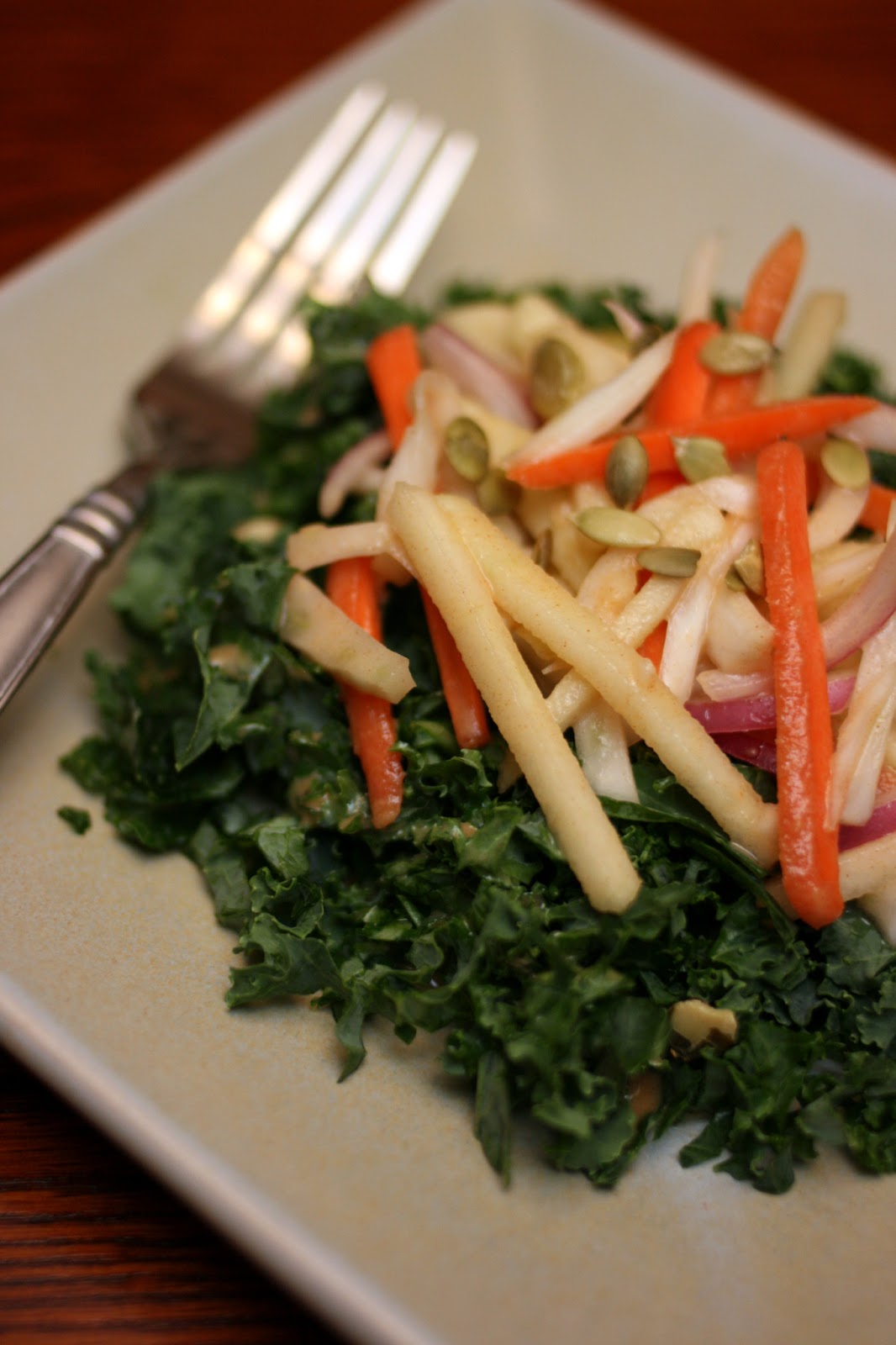
Kale and Fennel Salad with Apples and Cinnamon
adapted from Cooking Close to Home
I love this salad because it's both mixed and separate, because the flavors both blend and are unique.  It's a good salad to serve beside a warm winter soup.

Dressing
2 T. olive oil
2 T. honey
2 T. cider vinegar
1 t. garlic, minced
1/4 t. cinnamon

Salad
1/2 c. fennel, julienne
1/2 c. apple, julienne
1/2 c. carrots, julienne
1/4 c. red onion, julienne
1 1/2 c. kale, very finely chopped
a handful of toasted pumpkin seeds

Blend dressing ingredients together using an immersion blender (great for emulsifying) or a whisk.  Set aside.

Combined julienned ingredients in a large bowl and toss with dressing.

Evenly divide the kale among the serving plates, and top with mixed vegetables and fruit (this is also a fun job for the almost two-year-old).  Sprinkle with toasted pumpkin seeds.
Pin It

Sunday, January 6, 2013

On the Boycott of Playdates, and Raw Broccoli Salad

When I was little, we lived in a neighborhood in which there were always kids within walking distance.  Two sisters my age lived across the street.  A family with three girls lived up the block.  Two little boys my brother's age lived around the block.  And while I wasn't around much after school because my parents were both teachers and we spent a good chunk of the afternoon commuting, it was still nice to know that if I was bored, all I had to do was go ring their doorbell.

As I got older, and was entrusted to go a little farther on my own, I had a friend who lived two streets away, and I'd ride my bike to her house, where we would spend long afternoons pretending in her attic.  And finally, when I got to high school, I'd head by bike to a friend's house two towns and several miles away.

I know that this is a different time and age than the one in which I grew up.  But there are some things that I don't know if we need to give up just yet.  Like the impromptu doorbell-ring.

There are some neighborhoods where this is not possible, for a host of reasons.  The houses are too far apart.  There aren't enough similarly-aged children in the neighborhood.  You folks get a pass.

And there are some neighborhoods where the impromptu doorbell-ring (or simply entering with a passel of friends without the extra step of ringing) is alive and well.  You folks aren't the people I'm talking about here, either.

We live on a street with no fewer than five boys and girls who are I's age.  There are also three children N's age.  And yet, hardly ever does anyone ring the doorbell.  Instead, we organize elaborate playdates, mostly with children who don't even live on our block.

My son and I were talking about this one night, after I'd put him to bed.  About how I dislike the word "playdate," because it feels so contrived.  Like our toddlers need iPhones from birth, scheduling their play and organizing their relationships.  And how the arrangement feels exclusive to me; once you've committed to a "playdate" with one friend, you can't add a third random friend to the mix, who happens to ring the doorbell.


Partially as a follow-up to the conversation, the next morning, on a Saturday, I sent I. up the block to his friend's house to ring the doorbell, with instructions that upon the door opening, he was to invite said friend over to our house to play.  "But what if they're not home?" he worried.

"Then come home," I answered.

"What if he doesn't want to come over here, and what if he asks me to go there?" he asked.

"Then ask to use the phone, and call us to tell us that you're going to stay," I said.  "That's fine with me, as long as I know where you are.  And I'll tell you when we'll come pick you up."

"What if he doesn't want to play?"

"Then tell him thanks anyway, and tell him that you'll see him later, and come home."

He seemed satisfied with this, and skipped up the street.  It turned out that his friend's mom wasn't able to open the door, but she called later to bring the friend over to play for a while.  My son was thrilled.

Even as adults, we seem to tiptoe around each others' lives.  We don't call up friends without a reason any more, because Facebook takes care of our quick check-ins.  We don't drop by randomly for a cup of coffee, at least, most of us I know don't.  Or I don't.  And I feel like it's a dying art, the art of the unexpected visit, the art of intrusive friendship.  I feel like it's an art my children need to learn, if they're going to learn to notice people, and care about them, even when those people don't tell them that they need to be cared about.

So I've decided that for now, I'm going to boycott playdates.  I'm going to randomly call up my friends and ask if they want to come play [*edited later to add: with as much acknowledgement of work schedules as possible, and understanding when people have prior commitments!].  I'm going to send my children to ring doorbells, and interrupt our over-scheduled lives.  I'm going to welcome people to my house if they come calling, and always have something I can throw together and offer up as a light lunch.  Because sometimes the most fulfilling moments are the ones we never put on the calendar in the first place.

Do you -- or your children, if you have them -- ring doorbells?  Or do you tend to make plans to see friends?

Broccoli and Kohlrabi Salad
I've been thinking about this salad as an antidote to all of the unhealthy eating from the holidays, and with a crusty loaf of bread, it's a perfect throw-together kind of meal that's fancy enough to offer a guest.  Kohrabi is cool-weather vegetable, and one of the first and last things that we get in our CSA shares.  If you're looking through seed catalogues yet, as we often do here in the midwinter, it might be something to add to your order.

1 head broccoli, stems removed and cut into florets
1 c. kohlrabi, finely chopped
1/2 c. golden raisins
1/2 c. sunflower seeds
1 avocado, peeled and pitted
3 T. lemon juice
3 T. orange juice
2 T. lime juice
2 T. apple cider vinegar
1 T. agave
3 T. oil of your choice
6-7 chive blossoms (you may not have these right now, so you can always use a scallion or two, but the chive blossoms are really lovely and light)

Toss together broccoli, kohlrabi, raisins, and seeds.  In a blender, blend remaining ingredients.  Pour over vegetables.

Break apart chive blossoms into small bits and scatter over the salad.
Pin It

Tuesday, August 14, 2012

A House of Compromise: Napa Cabbage Salad

I might as well confess this: my husband is a Republican.  In case you haven't been reading for very long, and didn't notice my political stripes ... well, let's just say I'm not a Republican.  Luckily we agree on the important ideological issues (at least, the ones I think are important), and disagree when it comes to issues of government size and fiscal responsibility.  It works for us.

As you found out in his guest post, my husband is an engineer.  He sees things with a scientific, rational, logical mind.  Me?  I was an English major, a Psychology minor, and got my doctoral degree in the Sociology and Philosophy of Education, heavy on the Philosophy.  I see things through the lens of metaphor, I am more likely to be emotional even when I'm being rational, and I am drawn to ideas about culture.  The difference offers us balance, most of the time, like when I want to cry about laundry detergent.  (Maybe sometime I will tell you that story, but not today.)

My husband is a carnivore.  He would be perfectly happy with a meal of hot dogs and mashed potatoes.  In fact, Thanksgiving at our house falls just short of a world war every year because though I am not exactly a vegetarian, I often eat that way, and I am the lone voice protesting the preponderance of starch and animal protein.  (A meal of sugar and fat, though?  Oh, ho!  Not a problem.)

Unlike most of our differences, which are completely surmountable or even useful, this last difference presents a challenge given that the CSA share is ... well ... full of vegetables.  And not just the flexible jack-of-all-trades vegetables like zucchini and tomatoes, but things like napa cabbage.  And eggplant.  And tomatillos.  I am way too lazy to make stuffed cabbage, and the idea of a whole head of cabbage worth of stuffed cabbage makes me a little weak in the knees.  I have eaten more baba ghanouj this summer than I thought possible, because everyone else who lives here thinks that eggplant is slimy.  And will someone please tell me what people do with tomatillos besides make salsa, or throw them in stew, which I really would prefer not to do when it's ninety degrees out?

I love my CSA.  LOVE, love my CSA.  But this is tricky business.

I remember having long conversations with a former colleague about her split household, and how she managed, as a vegetarian, to cook for herself and her vegetable-hating husband (not that my husband hates vegetables ... he just doesn't love them like I do).  At the time, they seemed like perfectly reasonable solutions: add beans to one half the meal, meat to the other.  But sometimes, like when you have a cabbage to contend with, it works less well.

You can, however, take a deep breath, compromise a little, and present your husband with a rack of ribs to grill as an enticement to eat said cabbage.  Which is exactly what I did.

Napa Cabbage Salad with Red Bell Pepper, Cilantro, Almonds, and Dijon-Ginger Dressing
(Adapted from Kalyn's Kitchen)

1 medium head napa cabbage, chopped (about 5-6 cups chopped cabbage)
1 red bell pepper, very thinly sliced into same-length slices
1/3 c. thinly sliced green onion
1/2 c. chopped cilantro
1/3 c. chopped almonds, toasted (or roasted, salted)

Dressing:
2 T rice vinegar
2 tsp. grated ginger root
2 tsp. Dijon mustard
3/4 tsp. sesame oil
1 T. agave nectar or 2 t. honey
salt and fresh-ground black pepper to taste
3 T. light olive oil

Stir together the rice vinegar, grated ginger, Dijon mustard, sesame oil, agave nectar/honey, salt, and pepper, then whisk in the oil one tablespoon at a time.  Set aside and allow flavors to mingle.

Toss together the chopped napa cabbage, red bell pepper, green onions, and chopped cilantro in a medium-sized salad bowl.  Add desired amount dressing and toss to coat the salad.  Place in salad bowls and top each serving with chopped almonds.  Serve and eat immediately, since the cabbage will begin to wilt in the refrigerator.
Pin It

Wednesday, July 11, 2012

Potato Humor

I'd read the prompts for NaBloPoMo in advance before we left for vacation, and honestly, some of them had me stumped.  Like the favorite joke, for example.  For all of the pranksters and jokesters in my family, I don't have an arsenal of jokes at my disposal.
 I asked my son, and he told me this one: "What kind of shirt does a golfer wear?  A TEE shirt!"

"Do you know why that's funny?" I asked him.

"No," he admitted.

I explained the joke, and then asked, "so how did you learn that joke?"

He shrugged.  "I read it on a popsicle stick today."

And really, isn't that just the sort of place you learned some of the favorite silly jokes from your elementary school years?

I asked around at the family reunion we went to, and the really funny thing?  Is that most people are still telling the same jokes they told in the third grade.

Potatoes are in season at my CSA.  So here are some seasonal third grade jokes for you ... and a potato salad.
 
How do you describe an angry potato? Boiling Mad.
What do you call a baby potato? A small fry!
What do you say to an angry 300-pound baked potato? Anything, just butter him up.
Why did the potato cross the road? He saw a fork up ahead. Why didn’t the mother potato want her daughter to marry the famous newscaster? Because he was a commentator.
Why wouldn’t the reporter leave the mashed potatoes alone? He desperately wanted a scoop.
Why do potatoes make good detectives?  Because they keep their eyes peeled.

GROAN.

Potato Salad (the bad-for-you old school kind)

A few red potatoes, boiled and sliced attractively
The spring onions (not to be confused with green onions) you didn't use from your CSA share last week
Some parsley that is about to go to seed, chopped finely
Hard cooked eggs, if you like them (I'm against segregated eggs, myself)
Anything else you feel like throwing in there, chopped finely
Stir together:
Mayonnaise, to your liking
Apple cider or red wine vinegar, a splash to thin the mayonnaise
A splash of water
Salt, preferably sea salt, to sprinkle liberally


Taste off the dressing.  If you don't like it, add something.  If you like it, pour it all over the top of your potatoes.  Refrigerate to let the flavors blend.
Pin It

Saturday, July 7, 2012

Ya Give me Fever: Cole Slaw

Last night I came down with a fever of 101.  It was sort of a shock; I don't really get sick like that very often, and I don't know about you, but I'm pretty bad at being sick ... because I'm reluctant to slow down and do what my body needs to do to recuperate.  I went to bed uncharacteristically early, at 8 (and then again at 10, because the first time I fell asleep on the couch), and woke up this morning with chills, which persisted throughout the day, giving way to a cough by evening.

You know those billboards that beg you not to go to work when you're sick, so you don't spread the germs?  Well, I'm here to remind you today that it has much less to do with epidemiology than it does with self-care.

Maybe this was a bad month to commit to NaBloPoMo.  But I'll post this tonight, in the interstices of my sleep and waking, and urge you to consume lots of vitamin C, available right now at your local farmer's market in the form of CABBAGE.

This isn't the cole slaw your mother used to make.  But if you can stomach anything  besides dry toast, it's an excellent way to dress up the traditional picnic dish.

Also: this is not a call for condolences.  ;)

Cole Slaw

1 head of cabbage, grated
2-3 large carrots, grated
1/2 c. golden raisins
1/2 c. thinly sliced green onions
1/4 c. rice vinegar
1 T. honey
1 T. OJ
1 t. sesame oil

Whisk honey together with rice vinegar.  Add sesame oil.

Pin It

Friday, May 25, 2012

Stop-Motion and Larb Gai (or Tofu)

Last night in yoga we practiced sun salutations in slow- and stop-motion.  Before putting a foot down, for example, we would hover it over the ground for a few seconds.  If this sounds like a huge pain to you practicing yogis out there, well, it was.  I've done sun salutations hundreds of times, and though my form is far from perfect, my body naturally glides through the flows of the asanas.  It was amazing to observe how different something feels, and how clumsy and unbalanced you become, when you take a habit out of practice, when you make yourself wait in an in-between.

Part of the point, my teacher explained (besides allowing us to concentrate on our form), was to become comfortable with in-between-ness, with the messiness that occurs when we are attentive to the process rather than rushing headlong to the endpoint or solution.

I am not good with in-between-ness.  It's not that I don't enjoy the journey from point A to point B, but rather that I generally live with my end goals in sight, and I tend to be hell-bent on arriving at them.  That's one reason this year has been a challenging one for me: the goals are fuzzier (though I suppose I could set more tangible writing goals), and the days less purpose-driven (short of the bullet pointed list of things to do that is always in my head, and which always includes laundry and making the next meal, sort of like a shopping list that always starts with bananas and milk).  I am less graceful in this state.  Sometimes it's downright ugly.

On the other hand, sometimes if we disrupt the "flow," the most wonderful, unexpected things can happen.  Not like hovering my right leg an inch above the floor before I put it down for a high lunge (which builds muscle tone but makes my quadriceps scream), but like discovering a new kind of tiny flower that grows in the cracks in the sidewalk, or having a conversation with someone you've never met, or gaining new perspective on how to resolve a difficult situation.

I used to travel internationally as often as I could; we were lucky to have parents who took us on vacation every year to some really remarkable places: Spain, France, Mexico, the Dominican Republic, Puerto Rico.  I had relatives in two of those places, so it wasn't that surprising that we traveled to see them, but saving for those trips was a priority in our house.  When I started living on my own, I continued to make travel a savings priority, and I visited (some with my husband) Alaska (which might as well be another country for me, given where I live!), South Africa, Brazil, Thailand, Japan, Canada, and a host of other places.  And when I think back, I remember that the best trips were the ones in which I didn't, guide-book in hand, spend all of my time worrying about getting to the next place.

So I'll encourage you to do something disruptive today.  Live for an hour in stop-motion.  And become comfortable, for a moment, in the in-between-ness, the point of transition, that makes change possible.

Larb Gai or Larb Tofu
This refreshing salad is generally made with chicken, but the tofu will sop up the flavor and dressing beautifully.  And if the shallot bites, live with it for a minute or so. :)

2 t. jasmine rice*
2 t. coconut or vegetable or peanut oil
3/4 lb. chicken or firm tofu, minced/crumbled (I use my cuisinart)
1 stalk lemongrass, sliced
2 T. fish sauce (nam pla)
1/3 c. broth
3 small shallots (1-2 large ones)
4 green onions, sliced on the diagonal
1/2 c. cilantro, chopped
1/2 c. mint, chopped
3 T. lime juice
1/2 lb. lettuce, shredded
1/4 c. roasted unsalted peanuts

(PSA: this first part is a real p.i.t.a., and we will understand if you decide to skip the rice bit.)
In a small pan over medium heat, toast the rice until it's fragrant.  Grind to a powder using whatever means you have available: mortar and pestle, small and powerful cuisinart, etc.

Heat oil in a medium skillet over medium heat.  Add chicken mince and cook thoroughly, stirring often to break up lumps.  Add broth, lemongrass, and fish sauce, and cook for another 10 minutes (but watch to make sure it doesn't burn; you may need to turn down the heat).  Remove from heat and allow mixture to cool.

Add shallots, green onions, cilantro, mint, and lime juice and stir to combine well.  Place lettuce on a serving platter, top with chicken mixture, and sprinkle with peanuts.

*You could omit the rice entirely, though I'm told that the flavor of the dish without the rice really makes it a different dish.
Pin It
Related Posts Plugin for WordPress, Blogger...